From Viking raids and Norman courts to Shakespeare’s quill and the BBC’s microphone — the history of British English is one of the most gripping stories ever told. And it is hiding inside every word you speak.
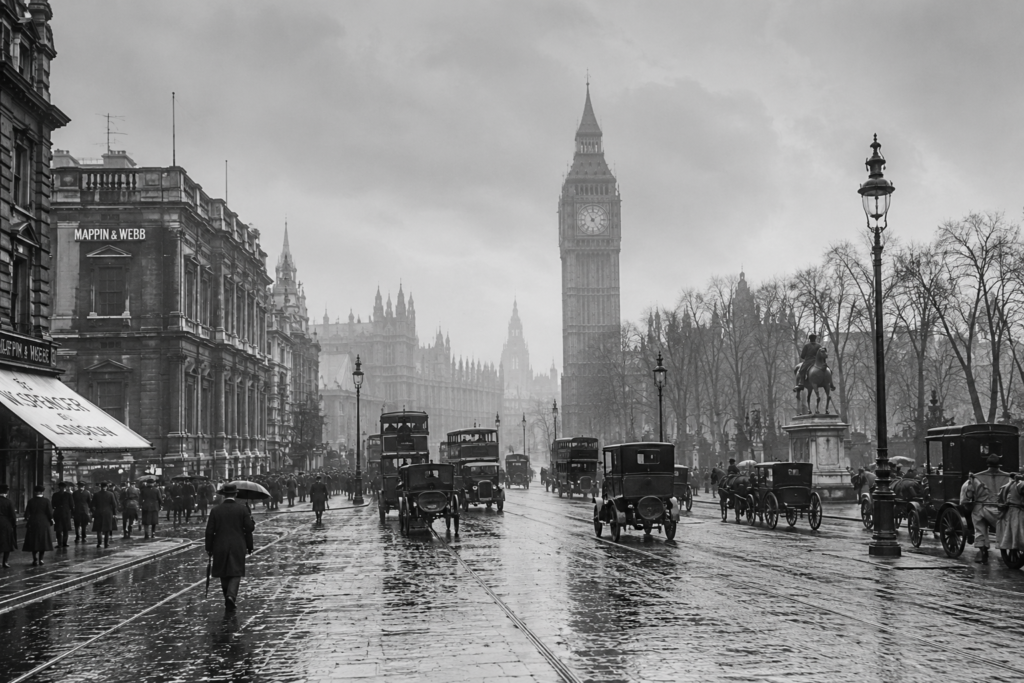
“The English language evolved over more than 1,500 years through invasion, literature, trade, and cultural exchange.”
It is raining in Canterbury. The year is 1386. A group of pilgrims — a knight, a prioress, a drunken miller, a shrewd merchant — are trading stories on the road to the shrine of Saint Thomas Beckett. The man recording their voices, Geoffrey Chaucer, writes in a language that is English, but barely recognisable as the one you are reading now.
Whan that Aprill with his shoures soote / The droghte of March hath perced to the roote.
Six hundred years later, those same roots are still here — inside the words April, drought, root, sweet. The language changed its face entirely, but its bones survived.
This is the history of British English: a story of conquest, collision, genius, and empire. It is the story of how a rough Germanic dialect spoken by farmers and fishermen became the language of Shakespeare, Newton, Churchill, and — eventually — the internet. Understanding this history is not an academic exercise. It is the key to understanding why British English sounds the way it does, why it carries the cultural weight it does, and why mastering it still opens doors that no other language variety quite can.
Keywords naturally embedded: British English history, history of the English language, British English origins, English language evolution, why learn British English, Received Pronunciation history, how English spread globally.
Table of Contents
Before English: The Island of Many Tongues
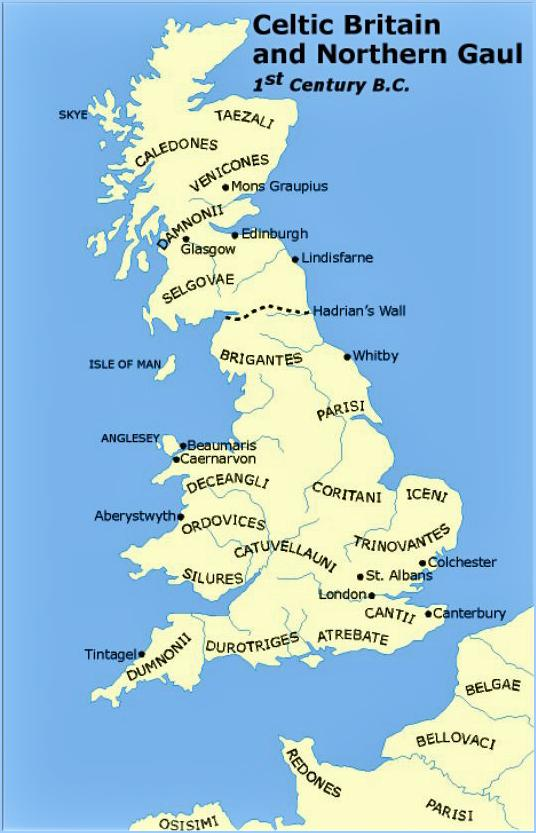
“Celtic tribes inhabited Britain long before English existed.”
To understand British English origins, you first have to understand what Britain sounded like before English existed at all.
The answer is: remarkable. Layered. Loud with languages.
The earliest inhabitants of the British Isles — the Celts — spoke a family of languages that survives today as Welsh, Irish Gaelic, Scottish Gaelic, Cornish, and Breton. These were rich, complex languages with sophisticated grammar and vast oral traditions. When the Romans arrived in 43 AD under Emperor Claudius, they found a Britain that was already ancient, already literary in its own way, already in possession of stories and laws and rituals conducted in Celtic tongues.
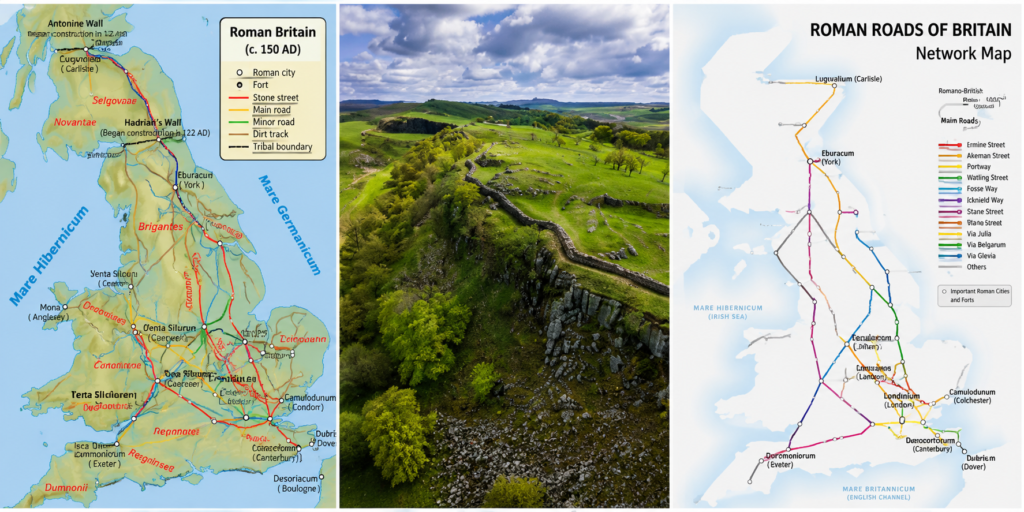
The Romans stayed for nearly four centuries, and they brought Latin. But crucially, they did not replace the Celtic languages — they simply ran alongside them. Latin became the language of administration, of written record, of military command, and of the new Christian church that was spreading through the island. Ordinary Britons went on speaking their Celtic languages and learned whatever Latin they needed for practical purposes.
When the Romans finally withdrew from Britain around 410 AD, they left behind Latin-laced place names, a Christianised population, and a physical infrastructure of roads and towns — but not a Latin-speaking population. The island went back to its Celtic roots.
And then, from the sea, came the Angles.
The Germanic Invasion: When English Was Born
In the 5th and 6th centuries, three Germanic tribes crossed the North Sea from what is now northern Germany and Denmark: the Angles, the Saxons, and the Jutes. They were farmers and warriors. They settled in waves, pushing the Celtic-speaking Britons westward into Wales and Cornwall and northward into Scotland.
The language they brought — which modern linguists call Old English, or Anglo-Saxon — bore almost no resemblance to what followed. Yet it is the bedrock.
Old English was a highly inflected language, meaning it used word endings rather than word order to show grammatical relationships. It had four grammatical cases, three genders, and a sound system dominated by guttural consonants and deep vowels. Reading the Old English epic Beowulf, composed sometime between the 8th and 11th centuries, is like reading a foreign language — which, in a sense, it is.
And yet.
The words that survive from Old English into modern British English are disproportionately the most used words in the entire language. They are the words we reach for without thinking — the words of the body, the hearth, the field, and the heart.
Water. Earth. Fire. Bread. Child. Mother. Father. Husband. Wife. House. Door. Moon. Sun. Night. Day. Dream. Death. Love.
Every one of those words is Old English. And that is no accident. The words we use most frequently, the words that carry the heaviest emotional weight, tend to be Germanic. When a poet wants to move you, they reach for Old English words. When they want to impress you, they reach for Latin. This pattern — Germanic for emotion, Latin for intellect — runs through the entire architecture of the English language, and it begins here.
The Viking Raids and the Words They Left Behind

Between the 8th and 11th centuries, Britain was repeatedly raided and eventually partly settled by Vikings from Scandinavia — primarily Danes and Norwegians. The Norse they spoke was closely related to Old English, which meant the two languages interacted with unusual intimacy.
The Danelaw — the northeastern portion of England under Viking control — became a zone of linguistic fusion. People were bilingual out of necessity. Traders, farmers, and neighbours needed to communicate across language lines, and communication requires compromise.
The result was a remarkable thing: English began to simplify. The complex inflectional endings of Old English started to erode. When two similar languages are spoken by the same community, the complicated grammar tends to fall away in favour of clearer word order. This is partly why modern English, unlike German or Russian, relies so heavily on the sequence of words in a sentence rather than on endings.
And the Vikings left behind hundreds of words that feel completely, instinctively English:
Sky. Skull. Skin. Egg. Knife. Window. Husband. Anger. Ugly. Wrong. Happy. Low. Flat. Get. Give. Call. Die. Take. Want. They. Them. Their.
That last trio is particularly striking. The third-person plural pronouns — they, them, their — are Old Norse. Old English had its own pronouns for this function, but Norse replaced them so completely that we no longer even know what the Old English versions sounded like in common speech. When you say “they went to the market,” you are using a Viking word.
1066 and All That: The Norman Conquest and the Language of Power
No single event in the history of the English language compares to the Norman Conquest of 1066.
On the 14th of October, William, Duke of Normandy — a man whose claim to the English throne was legally tenuous and personally very determined — defeated King Harold II at the Battle of Hastings. Harold died, tradition says, with an arrow through his eye. William became King of England, and England was never the same.
William and his Norman nobility spoke Old French — specifically a dialect called Anglo-Norman. And for roughly the next 300 years, the ruling class of England conducted their affairs in French. The royal court spoke French. Legal proceedings were in French. The church’s highest offices were held by French speakers who corresponded in French. Educated literature was written in French.
English went underground. It became, quite literally, the language of the working class — the language of the conquered.
And something extraordinary happened in that underground.
Over three centuries, the two languages did not simply fight for dominance. They fused. English absorbed thousands of French words, and in doing so, it gained something it had never fully had: layers of register. The capacity to say the same thing in multiple ways, each carrying different social and emotional weight.
The classic example is the division between animal and food. The Anglo-Saxon farmers who tended the animals used English words — cow, pig, sheep, deer, calf. But when that meat arrived cooked on the Norman lord’s table, it wore French dress — beef (from French boeuf), pork (from porc), mutton (from mouton), venison (from venaison), veal (from veau).
The class divide was written directly into the vocabulary. And echoes of it remain today.
Think of these pairs: begin / commence. end / conclude. ask / inquire. buy / purchase. rise / ascend. holy / sacred. goodness / virtue. kingly / royal. wish / desire.
In each case, the first word tends to be Germanic — older, earthier, more direct. The second is French or Latin — more formal, more elevated, slightly more distant. This is not coincidence. It is the archaeology of a conquest still audible in everyday speech.
The result was a language of almost inexhaustible richness. English can approach a concept from three different directions — Germanic, French, Latin — and carry three different registers in doing so. No other major European language has this to quite the same degree. It is one of the reasons English literature is capable of what it is capable of. The writer has more tools than in almost any other language.
A Small Story: The Lord and the Farmer
There is a farm in Lincolnshire, somewhere in the year 1150.
The farmer, whose name in the record might be Wulfric, rises before dawn as he always has. He tends his swine — the English word — and his cows and his sheep. He speaks to his wife in English, prays in English, argues with his neighbours in English.
On Sunday, the lord of the manor — a Norman named Renaud de Montfort — rides past on horseback. He gives his instructions in French, and the farmer nods, understanding perhaps one word in three. The rest he fills in from context.
That evening, Renaud dines on porc rôti. Wulfric eats pork.
It is the same animal. It is not the same world. But their two words will survive together, and the distance between them — that elegant, stubborn gap between the field and the table — will still be audible in English eight hundred years later.
Middle English: The Language Finds Its Feet
By the 13th and 14th centuries, English had begun to recover its footing. The Norman nobility, now several generations removed from Normandy, were slowly losing their fluency in French. The Hundred Years’ War with France made French seem less prestigious and English more patriotic. Parliament began conducting business in English. English literature began to flourish again.
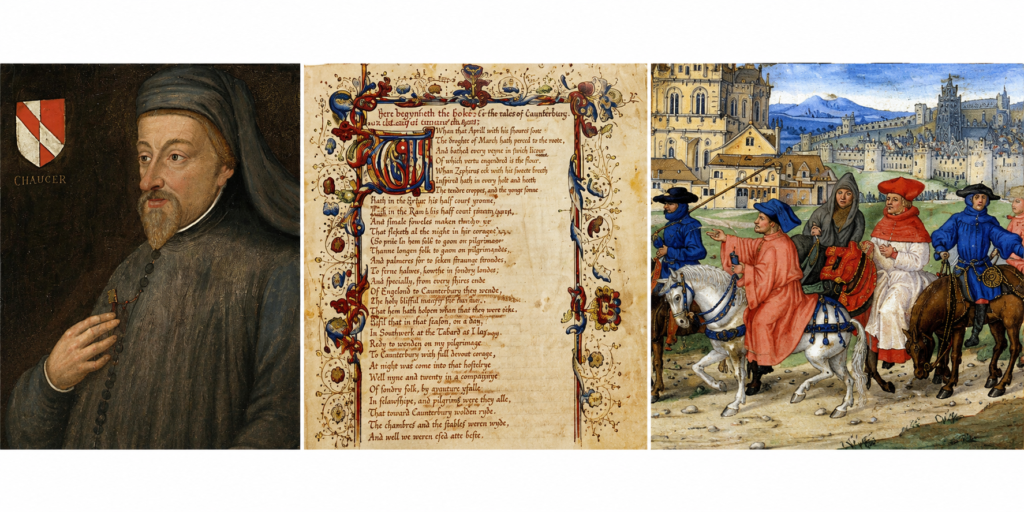
The period we call Middle English — roughly 1150 to 1500 — produced one of the greatest writers in the language’s history: Geoffrey Chaucer.
Chaucer’s Canterbury Tales, written in the 1380s and 1390s, is a snapshot of English in glorious transition. It is a language that has absorbed French, that still carries its Germanic bones, that is experimenting with Italian literary forms, and that is very much alive — alive in the way only spoken language truly is. Chaucer writes comedy and tragedy, sacred devotion and bawdy humour, all in the same tongue.
Middle English is still foreign to modern eyes, but it is approaching. He was a verray parfit gentil knyght — he was a truly perfect, gentle knight. The words are there. The spelling is different. The pronunciation would sound almost like singing.
But the language was about to be standardised. And standardisation would change everything.
The Printing Press: The Moment English Was Fixed
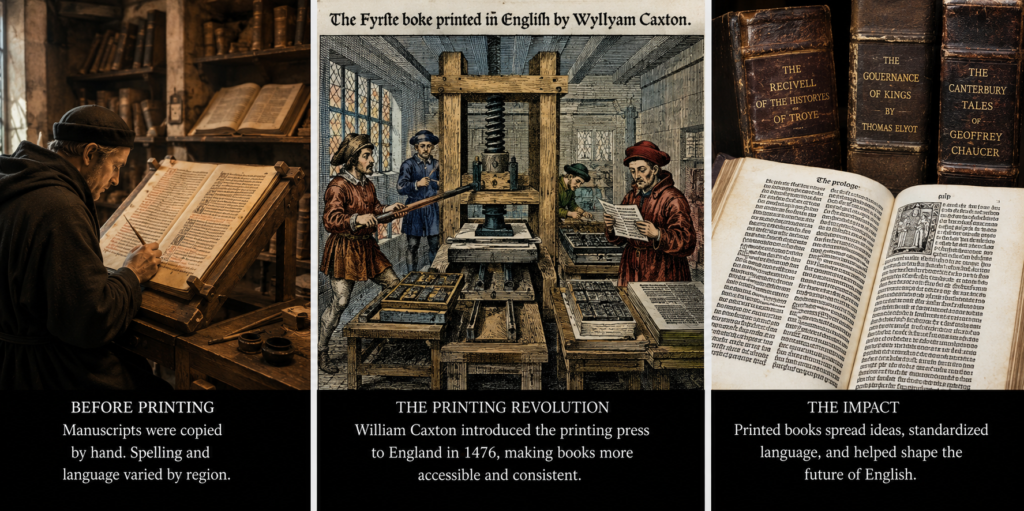
In 1476, a merchant named William Caxton returned to England from the European continent with a printing press — the first on English soil.
The printing press is perhaps the most transformative technology in the history of British English. Before it, there was no standard written English. Every manuscript was copied by hand, and scribes spelled words however seemed sensible to them, in whatever regional dialect they wrote. A document written in Kent was barely recognisable to someone from Yorkshire. There were dozens of Englishes, not one.
Caxton had to choose. For his books to sell widely, he needed to print in a dialect that the most people could read. He chose the dialect of London and the East Midlands — the commercial and political heart of England, the dialect already carrying the most prestige simply by virtue of where it was spoken.
And because his books spread across the country, that choice propagated. The spellings he used became the spellings. The vocabulary he chose became standard. The grammar conventions his books modelled became the norm.
This is the origin of Standard English — and it is worth dwelling on the arbitrariness of it. Standard English was not chosen because it was linguistically superior to the dialect of Cornwall or Yorkshire or Scotland. It was chosen because it was useful — because it could be printed and distributed and read by the most people.
But power followed utility. And with power came the concept that there was now a wrong way to write English. The printing press created the written standard, and the written standard created the idea of error. Linguistic snobbery — the judgement of people by the way they write and speak — begins, in a meaningful sense, with Caxton’s press.
The Renaissance and the Great Latin Inheritance
The 16th century brought the Renaissance to England, and the Renaissance brought a crisis: English did not have enough words.
The flood of new ideas from Italy and ancient Greece — in philosophy, medicine, mathematics, astronomy, architecture, rhetoric — required vocabulary that simply did not exist in English. What was a writer to do when trying to explain the concept of atmosphere? When describing the mechanics of the skeleton? When articulating the rules of rhetoric?
They borrowed. Heavily, shamelessly, brilliantly.
Scholars, translators, and writers reached into Latin and ancient Greek and pulled out words by the thousands. This period — the late 15th through 17th centuries — saw the English vocabulary expand at a rate that has never been matched before or since. Conservative estimates suggest over 10,000 words entered English from Latin and Greek during this period alone.
Anatomy. Atmosphere. Catastrophe. Critic. Democracy. Electricity. Enthusiasm. Excerpt. Expensive. Explain. Fact. Frugal. Genius. Habitual. Hemisphere. Halo. Idiosyncrasy. Ingenious. Janitor. Larynx. Meditate. Misanthrope. Necessitate. Oblivion. Parasite. Pestilence. Rarity. Skeleton. Splendid. Strenuous. Tenacious. Thermometer. Vacuum. Verbose.
Not everyone was pleased. Conservative scholars launched what became known as the inkhorn controversy — arguing that these imported Latin and Greek words were pretentious, unnecessary, and incomprehensible to ordinary people. They called them “inkhorn terms” — the kind of obscure language only a scholar with ink-stained fingers could love. Some of their complaints had merit. Many of the borrowed words were redundant, replaced existing English words that were perfectly serviceable, and promptly faded away.
But the survivors are now indispensable.
And then there was Shakespeare.
A Small Story: The Playwright Who Could Not Stop Inventing
It is 1603. A playwright is sitting in a candlelit room in Southwark, writing.
He has a problem. He is writing a scene in which a character must describe, precisely, the experience of shame in the presence of someone else’s embarrassment. The English language does not have a word for this. He could use a phrase. He could work around it. He is the greatest writer alive and he could manage.
He does not manage. He invents.
The word he reaches for — something that means vicarious embarrassment, a feeling of shame on another’s behalf — does not yet exist. He bends the language until it gives him what he needs.
William Shakespeare did this over 1,700 times. Words we use without a second thought — bedroom, obscene, addiction, generous, lonely, negotiation, moonbeam, lackluster, undress, manager, bedroom, cold-blooded, eyeball — were first recorded in his plays. Not because he invented them from nothing; some were in circulation, unwritten. But because he put them on a stage, in the mouths of characters who felt true, they entered the permanent record.
The history of British English is full of geniuses. But only one of them was Shakespeare.
The King James Bible (1611): When English Became Sacred
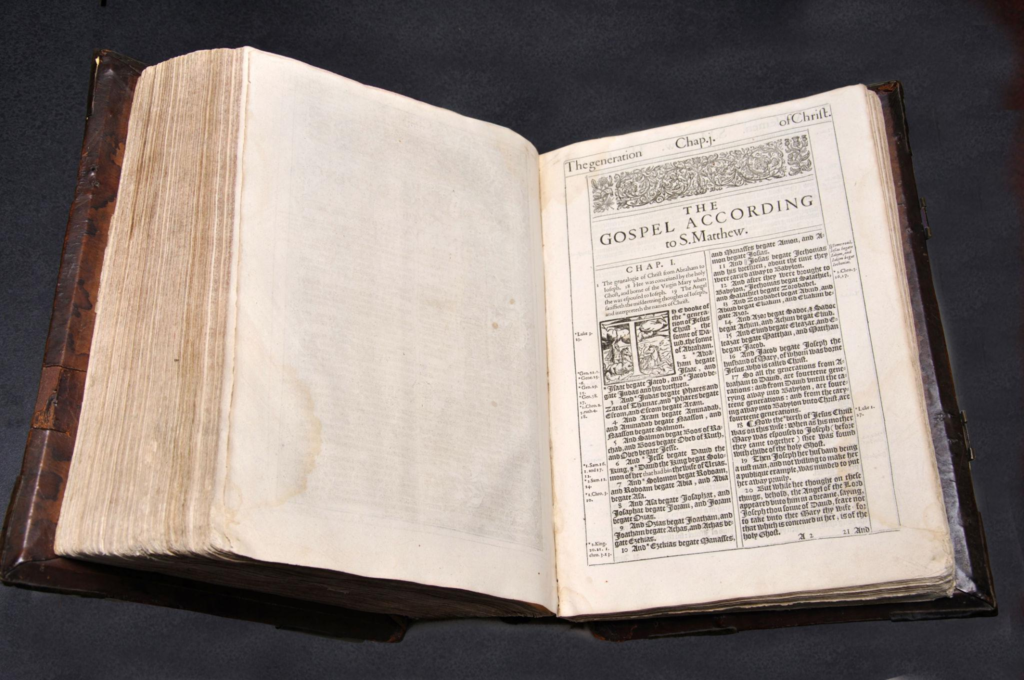
In 1611, a committee of scholars authorised by King James I produced an English translation of the Bible that would shape the English language more profoundly than any single piece of writing before or since.
The King James Bible was not just a religious document. It was a literary masterpiece — a text crafted by scholars who understood that its sentences would be read aloud, memorised, and repeated millions of times across centuries. The rhythm of the language was therefore as important as its accuracy. The translation team laboured over sentence cadence, vowel sounds, the weight of syllables.
The result was a prose style of extraordinary power. In the beginning was the Word, and the Word was with God, and the Word was God. The parallelism of that sentence, the repetition, the way it builds — this is not accidental. This is craftsmanship.
Phrases from the King James Bible entered the living English language so thoroughly that speakers who have never opened the text use them daily without knowing:
Salt of the earth. A fly in the ointment. A thorn in the flesh. The writing on the wall. By the skin of your teeth. Cast pearls before swine. Go the extra mile. The powers that be. A labour of love. Fight the good fight. An eye for an eye. The straight and narrow. Broken-hearted. Rise and shine. Bite the dust.
These are not archaic phrases. They are alive. They are used in offices and arguments and love letters and sports commentary. The King James Bible gave British English a moral and metaphorical vocabulary that has never needed updating — because it got it right the first time.
The Great Vowel Shift: Why English Spelling Makes No Sense
Between roughly 1400 and 1700, something extraordinary and deeply strange happened to English pronunciation: it shifted, dramatically and systematically, across the entire vowel system.
Linguists call it the Great Vowel Shift, and it is one of the most significant events in the history of the English language — as well as the principal explanation for one of English’s most notorious features: the absurd gap between spelling and pronunciation.
Before the Shift, English vowels were pronounced more or less as they are in most European languages today — what linguists call their “continental values.” The word name was pronounced something like nah-meh. Time was pronounced like teem. House was pronounced like hoose. Meet rhymed with mate does today.
Then, over the course of roughly three centuries, every long vowel in English raised itself one position in the mouth. The vowels that were already at the top of the mouth — ee and oo — had nowhere further to go, so they became diphthongs (double vowel sounds). Teem became time. Hoose became house.
The crucial problem is that the printing press had already fixed English spelling by the time the Shift completed itself. The written language had been standardised in the 15th century based on pronunciations that then changed radically over the following two centuries. The spelling system was essentially frozen while the spoken language kept moving.
This is why knight has a silent k and a silent gh — because both were once pronounced. This is why name and have look like they should rhyme — because once, they essentially did. This is why read (present tense) and read (past tense) are spelled identically but pronounced differently. English spelling is, in many respects, a fossil record of a pronunciation system that no longer exists.
For the learner of British English, this is frustrating. But it is also fascinating — every apparently illogical spelling is a clue to the language’s evolution, a window into a world where the words sounded entirely different.
Received Pronunciation: The Accent That Was Manufactured
When most people around the world think of a “British accent,” they are imagining Received Pronunciation — RP. The vowels are long and clear. The final “r” is silent. The consonants are crisp. It sounds, to many ears, elegant. Authoritative. Precise.
But RP was not ancient. It was not natural. It was, in a very meaningful sense, manufactured.
RP developed primarily among the English upper and upper-middle classes in the 18th and 19th centuries, and it was deliberately promoted through the institutions that defined social prestige in Britain: the elite private schools (known as “public schools”) — Eton, Harrow, Winchester, Rugby — Oxford and Cambridge universities, the legal profession, Parliament, and, decisively, the BBC.
The BBC’s role in promoting RP cannot be overstated. When the British Broadcasting Corporation began radio broadcasts in 1922, it made a deliberate policy decision to use RP as its broadcast standard. The rationale was practical — RP was the most widely understood accent across the country, having been deliberately cultivated to strip regional markers. But the effect was to present RP as the correct form of spoken English, and all other accents as departures from that standard.
For decades, BBC announcers spoke in meticulous RP. News was delivered in RP. Drama was performed in RP. The unconscious message was clear: this is how educated people sound.
The specific features of RP that mark it as distinctive — and which give it its quality of precision and clarity — include:
Non-rhoticity: The “r” is not pronounced at the end of words or before consonants. “Car” becomes “cah.” “Better” becomes “bettah.” This absence of the final “r” is one of the most immediately recognisable features of British English to American ears, and it developed as a prestige feature in southern England in the 18th century.
The long “ah” vowel: Words like bath, path, dance, can’t, grass, castle, after are pronounced with a long, open “ah” vowel in RP — the so-called “trap-bath split.” Northern English dialects maintain a short “a,” and the distinction is one of the most socially loaded in British English.
Clear vowel distinctions: RP maintains precise, consistent distinctions between short and long vowels that can erode in casual speech.
Smooth, unhurried delivery: RP does not rush. There is a measured quality to its rhythm that conveys, whether intentionally or not, the impression that the speaker has time — that they are not anxious, not hustling, not performing.
This measured quality is, of course, a class signal. People who were educated at leisure, who never needed to sell themselves quickly, who had the confidence of inherited position — they developed a speech style that embodied that ease. And then that style became the model.
Is RP superior to any other form of English? Linguistically, no. A Glasgow accent is no less complex, no less expressive, no less rule-governed than RP. The prestige of RP is social, not linguistic. But social reality is reality, and in the context of international communication, formal writing, and professional settings worldwide, RP or something close to it remains the aspirational standard.
The Empire Writes Back: British English Goes Global
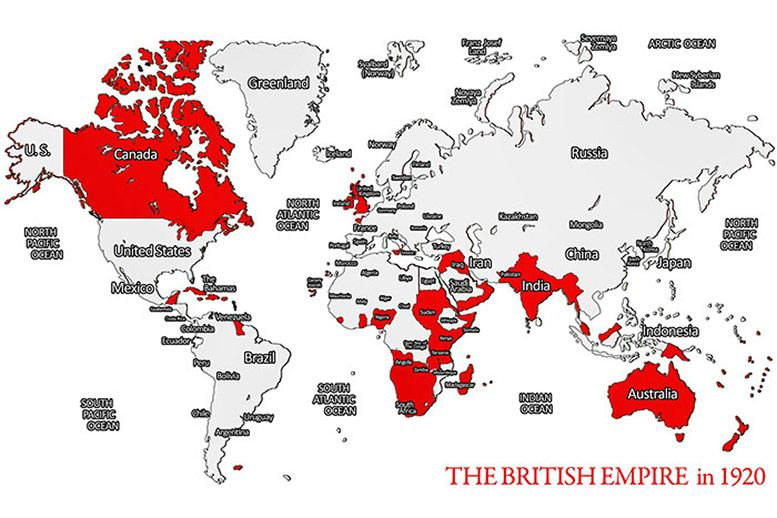
The story of how British English spread globally is inseparable from the story of the British Empire — and the moral complexity of that history must be held alongside the linguistic one.
Between the 17th and 20th centuries, Britain built the largest empire in recorded history. At its peak in the early 20th century, the British Empire governed roughly 458 million people across every inhabited continent. It covered a quarter of the world’s land surface. And wherever it went, it brought its language.
In India — the jewel of the Empire — the British established an educational system explicitly designed to produce what the colonial administrator Thomas Macaulay famously described in 1835 as persons “Indian in blood and colour, but English in taste, in opinions, in morals, and in intellect.” English became the language of law, higher education, government administration, and social advancement. The Indian Civil Service examination was conducted in English. The courts deliberated in English. To succeed in the colonial system — and in many cases simply to survive — English was essential.
The same pattern repeated across Africa, Southeast Asia, the Caribbean, and the Pacific. English was not merely taught; it was imposed. Indigenous languages were often suppressed or marginalised. The language of power was English, and the form of English that carried the most power was the most British form — educated, formal, and modelled on RP or something close to it.
The result was a global diffusion of British English that left permanent marks on the world’s linguistic map. But it also produced something its architects almost certainly did not anticipate: the colonised peoples took English and made it their own. They bent it, stretched it, infused it with local vocabulary and cadence, and created new forms of the language — Indian English, Nigerian English, Singaporean English, Caribbean English — that are vivid, creative, and linguistically sophisticated in their own right.
The Empire intended to export British English as a fixed, correct standard. Instead, it helped create a family of Englishes — all legitimate, all alive, all deeply indebted to and independent from their British origins.
A Small Story: The Magistrate’s Vowels
Calcutta, 1891. A young clerk named Suresh Chatterjee has just passed his English examination with the highest score in his district.
His supervisor — a bored Englishman named Alderton — interviews him and is slightly unsettled. Suresh’s written English is impeccable. His vocabulary is extraordinary. But his accent is unmistakably Bengali, his intonation rising where English intonation falls.
“You’ll need to work on the pronunciation,” Alderton says.
Suresh nods and says nothing. In the evenings, he listens to the English officers at the club — the long vowels, the clipped consonants, the air of unhurried certainty — and practises in his room.
Twenty years later, Suresh is a magistrate. His English is a thing of precision. When he reads a judgment aloud, the court goes quiet.
But at home, in the evenings, he speaks to his children in Bengali. The English is a tool, he tells them. An extraordinary tool. But it is not who you are. Who you are is not contained in any single language.
He was right. And decades later, his grandchildren would prove it — writing in an English that is entirely their own.
The Countries That Carry British English
The global reach of British English today encompasses dozens of countries across six continents. Understanding this geography enriches the understanding of the language itself.
India is perhaps the most significant case. With over 125 million English speakers — a number that is growing rapidly — India has produced some of the most vital English-language literature of the 20th and 21st centuries. Writers like Salman Rushdie, Arundhati Roy, Vikram Seth, and Jhumpa Lahiri write in English that is, in form, British — the spelling conventions, the grammatical traditions — but in spirit, texture, and imagery, entirely their own. Indian English has given the world words like prepone (to move a meeting earlier), out of station (out of town), and timepass (something done to kill time). It is a language variety of extraordinary energy.
Australia and New Zealand maintain British spelling conventions — organise, colour, theatre, programme — and their formal grammatical traditions are British. But their accents diverged from British English in the 19th century, influenced by the mixing of settlers from different British regional backgrounds, and their vocabulary reflects a completely different physical reality: billabong, bush, station (meaning a large farm), arvo (afternoon). The relationship with British English is filial — a child that has grown into its own person.
South Africa carries one of the most interesting English-language stories. The country’s English-speaking population descends primarily from British settlers, but English exists alongside Afrikaans and eleven other official languages. South African English has borrowed richly from Afrikaans and from Zulu, Xhosa, and other indigenous languages, creating a variety with its own unmistakable character.
Nigeria, Ghana, Kenya, and Tanzania all use British English as their formal standard — the language of law, higher education, formal journalism, and government. Nigerian English has produced extraordinary writers including Chinua Achebe, Wole Soyinka, and Chimamanda Ngozi Adichie, whose work is simultaneously rooted in British English conventions and in narrative traditions that owe nothing to Britain at all.
Singapore and Malaysia use a formal British English in official and educational contexts, while everyday speech has evolved into Singlish and Manglish respectively — vibrant creoles that mix English with Malay, Mandarin, Tamil, and Hokkien.
The Caribbean — Jamaica, Barbados, Trinidad, and others — has produced English-based creoles and varieties that are among the most sonically beautiful forms of the language in existence. Caribbean English has given global culture reggae, calypso, and writers like Derek Walcott (Nobel Prize in Literature, 1992) and V.S. Naipaul.
Ireland occupies a complex position — English was largely imposed during British colonisation, supplanting Irish Gaelic in many regions. And yet Irish English — the language of Yeats, Beckett, Joyce, Heaney — has produced a disproportionate share of the greatest English-language literature in history. There is an argument that colonisation, by forcing a people to bend a foreign language to their own consciousness, produces a particular literary intensity.
British English vs. American English: The Great Divorce
The most significant split in the history of the English language after the Norman Conquest was the American Revolution.
When the American colonies declared independence in 1776, the separation was not merely political. It was, gradually, linguistic. And its primary architect was a man named Noah Webster — a lexicographer with strong views about what a new nation’s language should look like.
Webster believed that American English should be distinct from British English. Not different in grammar or syntax — American English did not reinvent its deep structure — but different in spelling and orthography, as a deliberate act of cultural independence. In his 1828 American Dictionary of the English Language, Webster standardised a series of spelling simplifications: colour became color, honour became honor, centre became center, theatre became theater, organise became organize (though the -ize ending is, in fact, also standard in British English). Programme became program. Plough became plow.
These were not purely aesthetic choices. They were political ones — small, daily declarations that America was not Britain.
The vocabulary divergence is equally interesting. Some American words are actually older — British English retained certain words that British English lost. Fall for autumn, for example, was the standard British term until the 18th century, when autumn took over in Britain while America kept fall. Gotten (the past participle of get) was standard in British English until the 19th century — America kept it while Britain dropped it for got.
Other differences reflect genuinely different realities. America had trucks, Britain had lorries. America had gas stations, Britain had petrol stations. America had apartments, Britain had flats. The physical world diverged, and the vocabulary followed.
Today, the tension between British and American English is partly a question of cultural power. American English dominates in technology, pop culture, film, and social media. British English maintains its authority in formal institutions, much of international journalism, and the educational systems of dozens of countries. The two varieties continue to influence each other, and the boundary between them grows more porous every year.
Neither is superior. But they are different — and knowing which one you are aiming for, and why, is an important clarity for any serious learner.
The Architecture of British English Vocabulary: Three Floors, Infinite Rooms
One of the most intellectually rewarding aspects of British English — and one that serious learners rarely hear explained clearly — is the three-layered architecture of its vocabulary.
Every major concept in English can typically be expressed using words from one of three distinct linguistic origins, and each layer carries a different social and emotional register.
The Ground Floor: Germanic. These are the oldest words in the language — the words inherited from Old English and Old Norse. They are physical, direct, emotional, and immediate. Fear. Pain. Love. Hate. Hope. Grief. Death. Birth. Blood. Bone. Flesh. Fire. Water. Earth. They are monosyllabic or short. They hit hard. When a poet wants to reach the gut, they go to this floor. When a character in a novel speaks plainly and without pretension, they live here. These words feel true in a way that formal vocabulary sometimes cannot.
The First Floor: French. These are words that arrived with the Normans in 1066 and in subsequent centuries of French cultural influence. They are often associated with society, politics, law, art, and social ritual. Justice. Pleasure. Marriage. Palace. Government. Religion. Fashion. Honour. Mercy. Gentle. Courage. Challenge. Question. Answer. Liberty. They carry a warmth and civility — the vocabulary of social life and formal interaction. Professional British English lives substantially on this floor.
The Second Floor: Latin and Greek. These are the intellectual words — the vocabulary of science, philosophy, medicine, theology, and formal argumentation. Hypothesis. Democracy. Vocabulary. Philosophy. Constitution. Ambiguous. Necessary. Circumstance. Significant. Phenomenon. Analysis. Synthesis. Elaborate. Contemplate. They are Latinate, often polysyllabic, and carry an air of considered thought. Academic writing, formal speeches, and professional correspondence draw heavily from this floor.
The mastery of British English — and this is the insight that distinguishes genuinely sophisticated users of the language from competent ones — lies in knowing which floor to build on for a given moment. A eulogy that lives only on the second floor feels cold and airless. A legal argument that lives only on the ground floor sounds unsophisticated. A political speech that weaves all three layers together — as Churchill did, as Obama learned to do, as Shakespeare did in every play — creates something that resonates at multiple levels simultaneously.
This is why British English produces the literature it produces. The tools are simply extraordinary.
The Wit, the Understatement, and the Culture Encoded in Language
To understand why British English sounds the way it does, you eventually have to confront a cultural phenomenon that is almost impossible to explain to someone who has not lived inside it: British understatement.
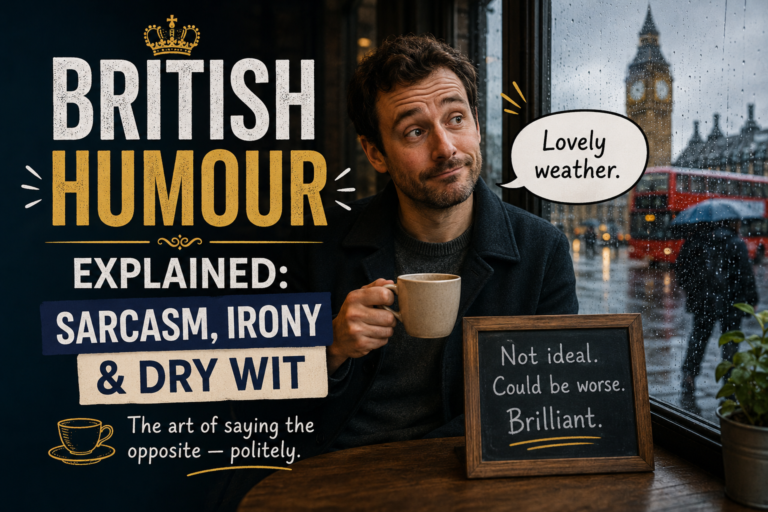
British history has shaped more than traditions and institutions; it has also influenced the distinctive way humour works in everyday conversation — explore our guide to [British humour, sarcasm, irony and dry wit].
British English does not typically express things at face value. It wraps them. It tilts them sideways. It implies rather than states, suggests rather than asserts, and — at its highest levels of social sophistication — manages to be intensely critical without raising its voice.
Where another culture might say “That was terrible,” British English says “That was quite interesting.” The word quite is doing tremendous work. In American English, quite is an intensifier — it means very. In British English, quite is a qualifier — it means moderately, or perhaps barely. And in certain tones, it means the opposite of good.
This is not dishonesty. It is a deeply held cultural value: that social harmony matters, that bluntness is slightly aggressive, that the intelligent listener should be able to read between the lines. The vocabulary of British understatement — rather, quite, somewhat, perhaps, I should think, not entirely, one might say, it occurs to me that — constitutes a sub-language of extraordinary nuance.
Then there is British irony. The capacity to say something while meaning its opposite — not sarcastically, but drily, with a deadpan delivery that makes it funnier and sharper precisely because it is never italicised. This irony is woven into the culture of the language so thoroughly that understanding it is, for many learners, the final stage of true fluency.
The class dimension of British English vocabulary also remains alive, though it has softened considerably. Certain words mark their speaker in ways that are immediately legible to a British ear: serviette versus napkin (working class versus upper class). Settee versus sofa. Lounge versus sitting room. Pardon versus sorry versus what. These distinctions carry the sediment of centuries of class consciousness — and a linguistically alert speaker can still read them.
British English Today: A Language That Has Never Stopped Moving
The history of British English does not end in any century. It is being written now.
The most vital, generative force in contemporary British English is the multicultural cities — above all, London, Birmingham, Manchester, and Bristol. London in particular has become one of the most linguistically diverse cities in the world, with over 300 languages spoken within its boundaries. And from that extraordinary mixing, a new variety of English has emerged: Multicultural London English (MLE), sometimes called “urban British English.”
MLE draws on Jamaican patois, Nigerian Yoruba and Igbo, Punjabi, Bengali, and a dozen other languages, as well as older British working-class London speech. Its vocabulary — mandem (one’s social group), bare (a lot of), peak (bad or unfortunate), peng (attractive), wagwan (what’s going on), ends (one’s neighbourhood), mad ting (an impressive thing) — has entered mainstream British youth culture with remarkable speed. Words that five years ago were heard only in specific postcodes are now in the mouths of young people across the country.
This is not the degradation of English. It is its continuation. Old English absorbed Norse. Middle English absorbed French. Modern English absorbed Latin and Greek. Contemporary British English is absorbing the linguistic energy of its newest communities.
Every generation has had its linguistic conservatives who believed the language was going to the dogs. Every generation has been wrong. The language does not degrade. It evolves. And it is evolving now, in front of our eyes, in exactly the way it always has — by taking what it needs from the world around it and making it its own.
Why You Should Speak It Beautifully
There is a question that hangs over any article about why to learn British English — a legitimate, important question: why does this particular form of the language matter?
The honest answer is not that it is superior. It is not. There is no linguistic hierarchy that places RP over Jamaican patois, or Standard British English over Nigerian English, or formal written prose over the vivid inventiveness of MLE. Every variety of English is linguistically complete. Every accent is capable of every thought.
But there are reasons to master British English — Standard British English, the English of formal writing, careful speech, and international professional contexts — that are both practical and, if you let them be, genuinely moving.
The practical reasons are real. British English is the formal standard for the educational systems, legal systems, and official communication of dozens of countries. It is the form of English used in international organisations, formal diplomacy, academic publishing, and much of the world’s journalism. It is the English of the IELTS, the Cambridge examinations, the British Council. Mastering it opens doors — not because the accent is beautiful (though it can be), but because the precision and range of formal British English gives you access to a register of communication that is respected globally.
But there is something beyond utility, and it is worth saying plainly.
When you speak British English with real care — when you understand its history, inhabit its vocabulary, hear the Germanic and French and Latin layers operating simultaneously — you are in contact with one of the great achievements of human language. You are using words that were shaped by Chaucer and Shakespeare and the translators of the King James Bible. You are speaking a language that carried Newton’s Principia into the world, that gave Keats the tools for his odes, that Orwell bent into an instrument of political clarity, that Toni Morrison used to perform feats of extraordinary beauty.
You are not imitating a foreign language. You are entering a living tradition that has been enriched by every culture that has touched it — and that continues to be enriched by every person who learns to use it with intention.
The history of British English is not a history of one people or one nation. It is a history of collision, adaptation, theft, and creativity. It is the history of language doing what language does: surviving.
And it is still going.
Language is shaped not only by history but also by culture. To see how one simple word reflects British manners and everyday life, read our article Why Do British People Say Sorry So Much? The Real Meaning in British English.
Closing: The Words Are Still Alive
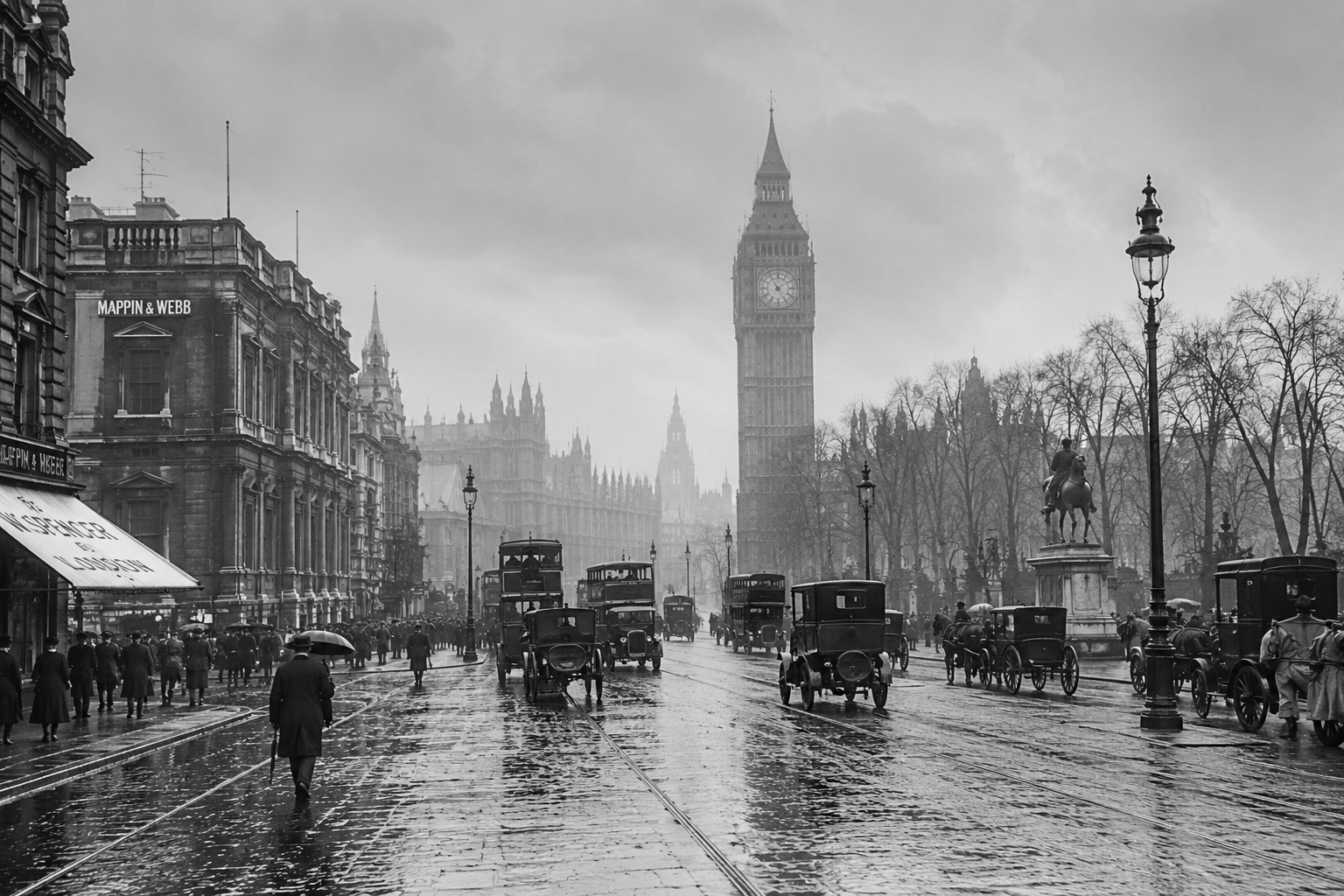
It is raining in London. It is always raining in London.
A woman on the Tube is reading a novel. A man at a café is writing an email to a colleague in Singapore. A teenager in Brixton is texting in a language their grandparents would not quite recognise. A judge in a court in Lagos is delivering a judgment in measured, formal English. A schoolgirl in Mumbai is reading Jane Eyre for the first time.
All of them are using the same language. A language that was once grunted by farmers crossing the North Sea. A language that bowed to French and then absorbed it. A language that Shakespeare stretched and the King James translators made sacred and the Empire spread across the world and the world made new.
Every word you read in this article is the product of that journey. The words are old. The words are alive.
And so, now, are you — if you are willing to learn them properly.