If you haven’t already, I recommend reading our previous article, The Fascinating History of British English, where we explored how English arrived in Britain and began its remarkable journey. In this guide, we’ll take a closer look at the three major stages of the language—Old English, Middle English, and Modern English—and discover how centuries of invasions, cultural exchange, literature, and innovation shaped the English we speak today.
Introduction
English is one of the world’s most influential languages, spoken by over 1.5 billion people across continents. It dominates international business, science, aviation, technology, entertainment, and education. Yet if you travelled back a thousand years and heard someone speaking English, you would probably understand almost nothing.
This surprises many learners. We often imagine languages changing slowly, but English has undergone one of the most dramatic transformations in linguistic history. Over fifteen centuries, it evolved from the language of Germanic tribes into today’s rich, flexible, and global means of communication.
Unlike many languages that developed in relative isolation, English absorbed influences from almost every culture it encountered. It borrowed words from Vikings, adopted thousands of French expressions after the Norman Conquest, embraced Latin and Greek during the Renaissance, and later welcomed vocabulary from India, Africa, the Americas, Australia, and countless other regions.
The history of English is therefore much more than a history of words. It is the story of migrations, wars, kings, monks, merchants, poets, explorers, inventors, and ordinary people whose everyday conversations gradually transformed the language.
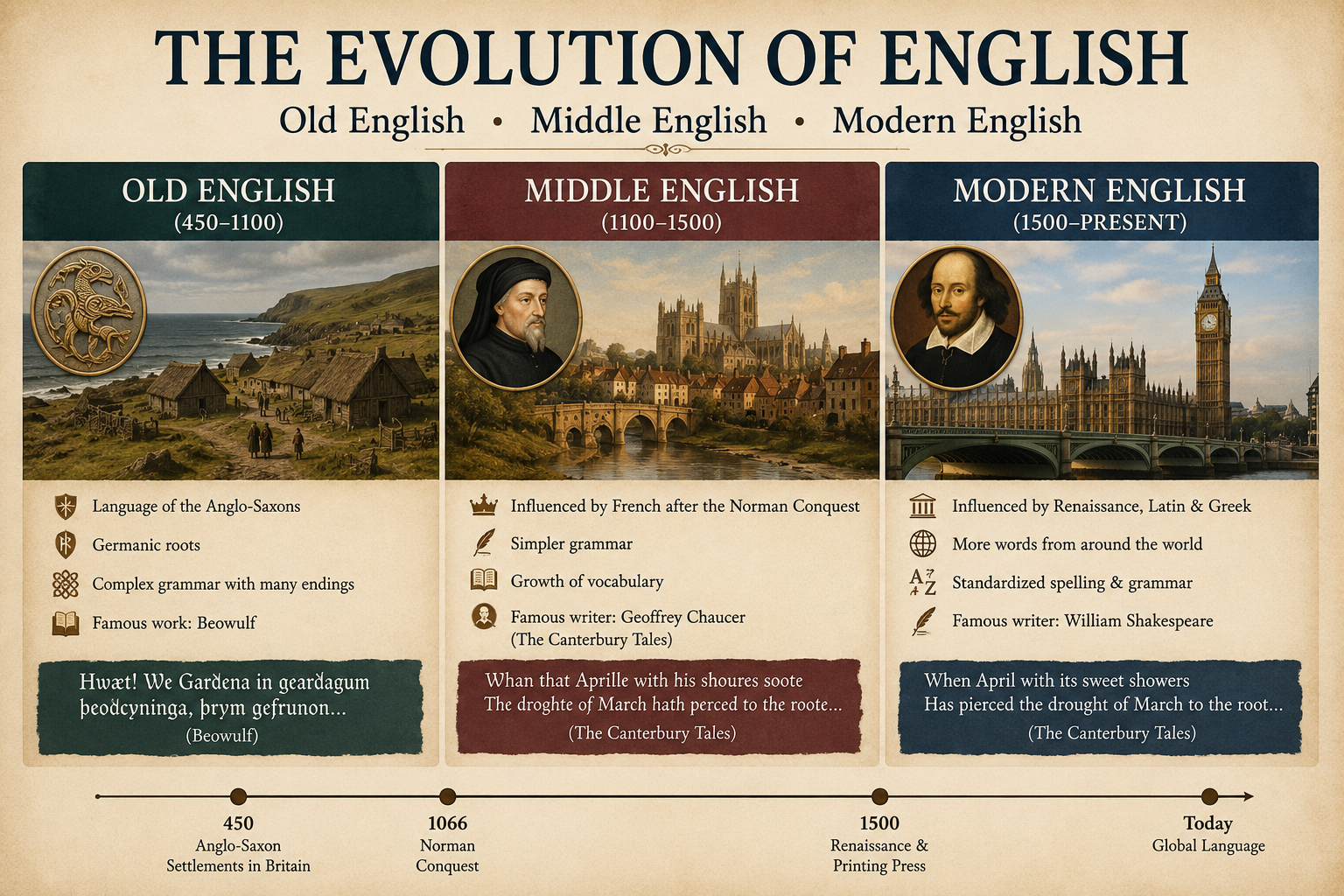
Linguists generally divide English into three major periods:
- Old English (c. 450–1100)
- Middle English (c. 1100–1500)
- Modern English (1500–Present)
Each period reflects profound changes in grammar, pronunciation, vocabulary, and writing. Understanding these stages not only deepens our appreciation of English but also explains why the language contains so many unusual spellings, silent letters, and seemingly unrelated words.
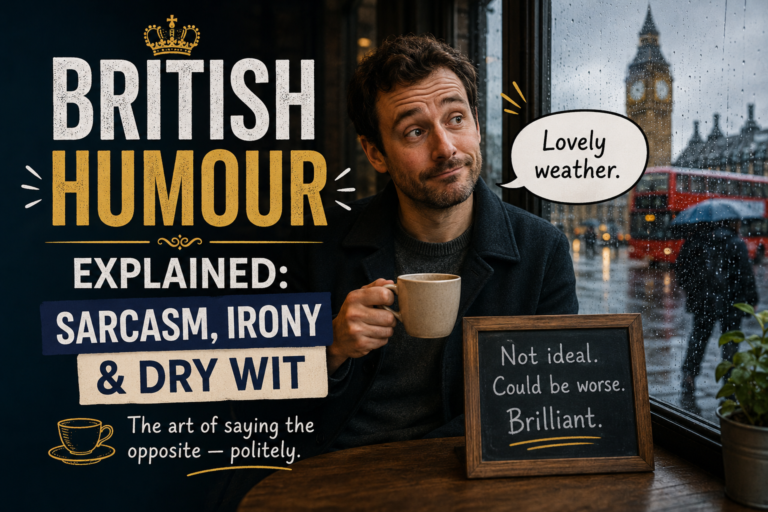
English has changed not only in vocabulary and grammar but also in how people communicate humour — explore our guide to [British humour, sarcasm, irony and dry wit] to discover how much meaning can hide behind a simple sentence.
A Timeline of English
| Period | Approximate Dates | Major Events |
|---|---|---|
| Before English | Before 450 AD | Celtic Britain, Roman occupation |
| Old English | 450–1100 | Anglo-Saxon settlement, Viking influence |
| Middle English | 1100–1500 | Norman Conquest, French influence, Chaucer |
| Early Modern English | 1500–1700 | Renaissance, Printing Press, Shakespeare |
| Late Modern English | 1700–Present | British Empire, Industrial Revolution, Global English |
This timeline helps us understand that English did not suddenly appear. It developed gradually over many centuries, with each historical event leaving a lasting mark on the language.
Before Old English: Britain Before the English Language
Before English existed, Britain was home to Celtic-speaking peoples. Their languages belonged to the Celtic branch of the Indo-European family and were spoken throughout the British Isles.
Although modern English contains relatively few Celtic words, traces of these early inhabitants remain in many place names.
Examples include:
- London
- Dover
- Kent
- Avon
- Thames
Many rivers in Britain still bear Celtic names because rivers tend to keep their original names even when new populations arrive.
In 43 AD, the Romans invaded Britain under Emperor Claudius. For nearly four centuries, Latin became the language of administration, law, military command, and educated society.
However, Latin never completely replaced Celtic. Most ordinary people continued speaking their native languages.
When the Roman Empire withdrew around 410 AD, Britain became vulnerable to invasion. This political vacuum created the conditions for one of the most significant migrations in European history.
The Birth of English
Around the middle of the fifth century, several Germanic tribes crossed the North Sea and settled in Britain.
These tribes included:
- The Angles
- The Saxons
- The Jutes
- Smaller Frisian groups
Each brought its own dialect.
Over time, these dialects blended into a new language that we now call Old English or Anglo-Saxon.
Interestingly, the word England comes from the Angles, whose name eventually became “Angle-land,” later shortened to England.
Similarly, English simply means “the language of the Angles.”
This language belonged to the Germanic family, making it much closer to modern German and Dutch than to French or Latin.
What Is Old English?
Old English was spoken from approximately 450 to 1100 AD.
Although it is technically English, it feels almost like a completely different language.
Consider the opening of Beowulf, one of the greatest works of Old English literature:
Hwæt! We Gardena in geardagum…
To a modern reader, this appears almost unreadable.
Yet it represents the earliest stage of the language we speak today.
Characteristics of Old English
A Highly Inflected Language
Perhaps the biggest difference between Old English and Modern English lies in its grammar.
Old English relied heavily on inflections, which are endings added to words to indicate their grammatical role.
Nouns changed according to:
- Case
- Gender
- Number
Adjectives also changed their endings.
Verbs had many more forms than they do today.
Because these endings indicated meaning, word order was relatively flexible.
Modern English, by contrast, depends largely on word order rather than endings.
Grammatical Gender
Like modern German, Old English assigned grammatical gender to nouns.
Every noun belonged to one of three genders:
- Masculine
- Feminine
- Neuter
These genders were often unrelated to biological sex.
For example, the word for “sun” was feminine, while “moon” was masculine.
This system eventually disappeared during the Middle English period.
Four Main Dialects
Old English was not completely uniform.
It consisted of four major regional dialects:
- West Saxon
- Mercian
- Northumbrian
- Kentish
Most surviving manuscripts, including many religious texts, were written in the West Saxon dialect.
A Different Alphabet
Old English used the Latin alphabet but also included several additional letters unfamiliar today.
These included:
- Þ (Thorn) – representing the “th” sound.
- Ð (Eth) – another version of the “th” sound.
- Æ (Ash) – pronounced somewhat like the “a” in cat.
- Ƿ (Wynn) – representing the “w” sound.
These characters gradually disappeared after the Norman Conquest as French scribes replaced them with spellings closer to those used today.
Old English Vocabulary
One fascinating fact is that many of the most common words in modern English come directly from Old English.
These include:
- father
- mother
- brother
- house
- bread
- water
- child
- wife
- man
- woman
- earth
- night
- sun
- moon
- hand
- foot
- drink
- eat
- sleep
These everyday words have survived for over 1,500 years, reminding us that although English has changed dramatically, its foundations remain remarkably strong.
Old English Literature
Despite being over a thousand years old, Old English produced remarkable literary works.
The most famous is Beowulf, an epic poem of more than 3,000 lines.
It tells the story of the heroic warrior Beowulf, who defeats the monster Grendel, Grendel’s mother, and eventually a fearsome dragon.
Although filled with mythical creatures, the poem also reveals much about Anglo-Saxon society, including ideas of courage, loyalty, honour, leadership, and fate.
Another important source is The Anglo-Saxon Chronicle, a collection of historical records kept by monks for several centuries.
It provides invaluable information about early English history, kings, battles, and daily life.
Everyday Life in Old English
Old English was not only the language of kings and poets.
It was the language of farmers working the fields, craftsmen building homes, merchants trading goods, monks copying manuscripts, and families gathered around evening fires.
Its vocabulary reflected a practical world centred on agriculture, family, religion, and survival.
Words relating to farming, weather, animals, seasons, and nature were especially common because these formed the heart of everyday life.
This explains why many of our most basic English words remain Germanic rather than French or Latin.
Could You Understand Old English Today?
The simple answer is no.
Even fluent native speakers of English cannot understand Old English without studying it.
Its grammar, spelling, pronunciation, and vocabulary differ so greatly from modern English that it is effectively a foreign language.
This often surprises learners who assume Old English is merely an older version of today’s language.
In reality, studying Old English is much like learning a completely different language with its own grammar, pronunciation, and writing system.
From Old English to Middle English: A Language Transformed
No language changes overnight.
The transition from Old English to Middle English was not the result of a single event but the outcome of centuries of invasions, cultural exchange, and political change. Between the eighth and eleventh centuries, two groups in particular reshaped English forever: the Vikings and the Normans.
Without them, Modern English would look and sound entirely different.
The Viking Influence on English
Beginning in the late eighth century, Viking raiders from present-day Denmark and Norway began attacking Britain’s monasteries and coastal settlements. Over time, these raids developed into permanent settlements, especially across northern and eastern England in an area known as the Danelaw.
Unlike many invaders, the Vikings did not simply conquer—they lived alongside the Anglo-Saxons. Farmers traded with farmers, children grew up together, and communities mixed. As a result, their languages blended naturally.
Old Norse, the language of the Vikings, was closely related to Old English. Because the two languages shared common Germanic roots, communication was surprisingly possible, although not always easy.
This close contact introduced hundreds of everyday words that remain part of English today.
Some familiar examples include:
- sky
- window
- egg
- knife
- husband
- law
- wrong
- anger
- skill
- cake
- skin
- take
- call
- die
- give
Many of these are such ordinary words that few people realise they were borrowed from Old Norse more than a thousand years ago.
Perhaps the Vikings’ greatest contribution was not vocabulary but grammar. Linguists believe that prolonged contact between English and Old Norse encouraged speakers to simplify complicated grammatical endings, making communication easier. This gradual simplification helped pave the way for Middle English.
An extraordinary fact is that even the pronouns they, them, and their come from Old Norse, replacing the original Old English forms.
The Norman Conquest: The Turning Point
If the Viking Age nudged English in a new direction, the Norman Conquest of 1066 completely changed its course.
Everything began with the Battle of Hastings, where William, Duke of Normandy, defeated King Harold II and became William the Conqueror.
The consequences reached far beyond politics.
For nearly three centuries, England became effectively bilingual.
French became the language of:
- the royal court
- government
- law
- the military
- education
- high society
Latin remained the language of the Church and scholarship.
English, meanwhile, continued to be spoken by ordinary people.
This created an unusual linguistic divide.
The wealthy spoke French.
The clergy wrote in Latin.
The common people spoke English.
Yet instead of disappearing, English survived. Over time, it absorbed thousands of French words while keeping its Germanic grammatical foundation.
This combination is one of the reasons English has such an exceptionally rich vocabulary today.
French Words That Changed English
The Norman Conquest introduced approximately 10,000 French words into English, and around three-quarters of them are still in use.
Many belong to fields connected with power and culture.
Government
- government
- parliament
- crown
- nation
- authority
Law
- justice
- judge
- court
- prison
- jury
Military
- army
- battle
- soldier
- captain
- enemy
Fashion
- beauty
- colour
- jewel
- mirror
- perfume
Food
One fascinating reminder of Norman society appears in food vocabulary.
The Anglo-Saxon farmers cared for animals using Germanic names:
- cow
- sheep
- calf
- pig
After the animals reached the tables of Norman nobles, they acquired French names:
- beef
- mutton
- veal
- pork
This simple difference still reflects medieval society nearly one thousand years later.
What Is Middle English?
Middle English developed between approximately 1100 and 1500.
It served as a bridge between the complex grammar of Old English and the more familiar language we recognise today.
Although still challenging, Middle English is much easier for modern readers to understand than Old English.
Compare these stages:
Old English
Hwæt! We Gardena…
Middle English
Whan that Aprille with his shoures soote…
Modern English
When April with its sweet showers…
Even without specialised training, most readers can recognise parts of Middle English.
Characteristics of Middle English
Several important changes took place during this period.
Simpler Grammar
Most grammatical endings gradually disappeared.
Nouns no longer changed according to complicated case systems.
Grammatical gender faded away.
Word order became much more important.
This simplification made English easier to learn and eventually helped it spread internationally.
A Growing Vocabulary
Middle English combined Germanic foundations with thousands of French and Latin words.
Instead of replacing older words, English often kept both.
For example:
- ask (Germanic)
- question (French)
- begin (Germanic)
- commence (French)
- freedom (Germanic)
- liberty (French)
These double vocabularies allow English speakers to choose between simple everyday words and more formal expressions.
Changing Pronunciation
Pronunciation also continued evolving.
Many words were still pronounced phonetically, but the sound system was gradually shifting toward Modern English.
This transition eventually led to one of the most remarkable events in linguistic history—the Great Vowel Shift.
Geoffrey Chaucer: The Father of English Literature
No discussion of Middle English is complete without Geoffrey Chaucer.
Writing during the late fourteenth century, Chaucer transformed English literature by proving that English—not just French or Latin—could produce sophisticated poetry.
His masterpiece, The Canterbury Tales, follows a diverse group of pilgrims travelling to Canterbury Cathedral.
Each pilgrim tells stories filled with humour, romance, morality, adventure, and satire.
The work provides a vivid portrait of medieval English society, bringing together people from nearly every social class.
More importantly, Chaucer elevated English to a respected literary language at a time when many educated people still preferred French or Latin.
For this reason, he is often called the Father of English Literature.
The Great Vowel Shift
Between roughly 1400 and 1700, English pronunciation underwent one of its most dramatic transformations.
This event is known as the Great Vowel Shift.
Long vowel sounds gradually changed, while spelling remained largely the same.
As a result, many English words are no longer pronounced the way they are written.
For example:
| Word | Earlier Pronunciation | Modern Pronunciation |
|---|---|---|
| time | teeme | time |
| house | hoos | house |
| name | nahm-eh | name |
| bite | beet-eh | bite |
This explains many of English’s famous spelling inconsistencies.
It also explains why Shakespeare’s pronunciation differed from ours, even though much of his spelling looks familiar.
Early Modern English (1500–1700)
The beginning of the Modern English period coincided with enormous cultural change.
Europe entered the Renaissance.
Exploration expanded across the globe.
Printing transformed publishing.
Scientific discoveries accelerated.
English adapted rapidly.
Thousands of new words entered the language from Latin and Greek, especially in medicine, astronomy, mathematics, philosophy, and science.
English was becoming increasingly capable of expressing complex ideas.
William Caxton and the Printing Press
In 1476, William Caxton introduced the printing press to England.
This invention changed English forever.
Before printing, books were copied by hand, and spelling varied widely from one writer to another.
Printing encouraged greater consistency.
Although spelling never became perfectly regular, published books gradually helped establish common standards across England.
The printing press also increased literacy, making books more affordable and accessible than ever before.
Shakespeare’s Extraordinary Influence
Few individuals have shaped English as profoundly as William Shakespeare.
Writing during the late sixteenth and early seventeenth centuries, Shakespeare demonstrated the remarkable flexibility of English.
His plays introduced memorable phrases still used today, including:
- break the ice
- wild-goose chase
- heart of gold
- love is blind
- green-eyed monster
Although many myths exaggerate the number of words Shakespeare invented, his greatest achievement was his creative use of existing language.
He showed that English could be poetic, dramatic, humorous, philosophical, and emotionally powerful all at once.
Late Modern English (1700–Present)
From the eighteenth century onward, English expanded faster than ever before.
Several historical developments accelerated its growth:
- the Industrial Revolution
- the British Empire
- scientific discoveries
- international trade
- global migration
- American influence
- cinema
- television
- the Internet
- artificial intelligence
During this period, English borrowed thousands of words from around the world.
From India came words such as bungalow, pyjamas, and shampoo.
From Australia came kangaroo and boomerang.
From Japan came tsunami, karaoke, and emoji.
English became one of history’s greatest linguistic collectors, happily adopting useful words wherever it encountered them.
Comparing the Three Stages of English
| Feature | Old English | Middle English | Modern English |
|---|---|---|---|
| Period | 450–1100 | 1100–1500 | 1500–Present |
| Vocabulary | Mostly Germanic | Germanic + French | Global vocabulary |
| Grammar | Highly inflected | Simplifying | Mostly analytical |
| Pronunciation | Very different | Transitional | Familiar today |
| Literature | Beowulf | The Canterbury Tales | Shakespeare and beyond |
| Ease for Modern Readers | Very difficult | Moderate | Easy |
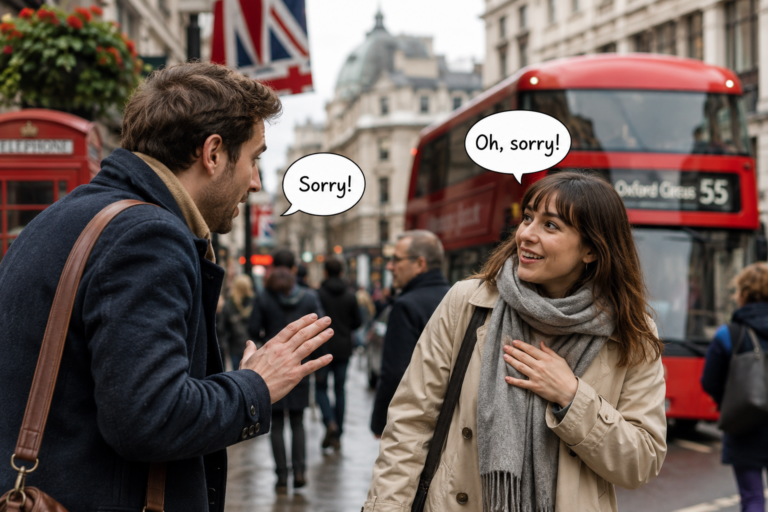
The English language continues to evolve through culture as well as vocabulary. Discover how one everyday word reveals Britain’s unique communication style in Why Do British People Say Sorry So Much? The Real Meaning in British English.
Fascinating Facts About English
- Around 80% of the words in Shakespeare’s works are still understood today.
- English has borrowed vocabulary from more than 350 languages.
- The Oxford English Dictionary continues adding hundreds of new words every year.
- Despite its French vocabulary, English remains fundamentally a Germanic language because its grammar and most common words are Germanic.
- The words we use most frequently—such as be, have, do, go, come, house, and mother—have survived from Old English for over fifteen centuries.
Conclusion
The story of English is a story of constant transformation.
Old English gave the language its sturdy Germanic foundation. Middle English enriched it with French elegance and simplified its grammar. Modern English expanded across the globe, embracing words, ideas, and cultures from every continent.
Rather than replacing its past, English built upon it. Every conversation we have today carries echoes of Anglo-Saxon farmers, Viking settlers, Norman nobles, medieval poets, Renaissance scholars, and modern innovators.
Understanding Old English, Middle English, and Modern English is more than a journey through linguistic history—it is a reminder that languages, like the people who speak them, are always evolving.