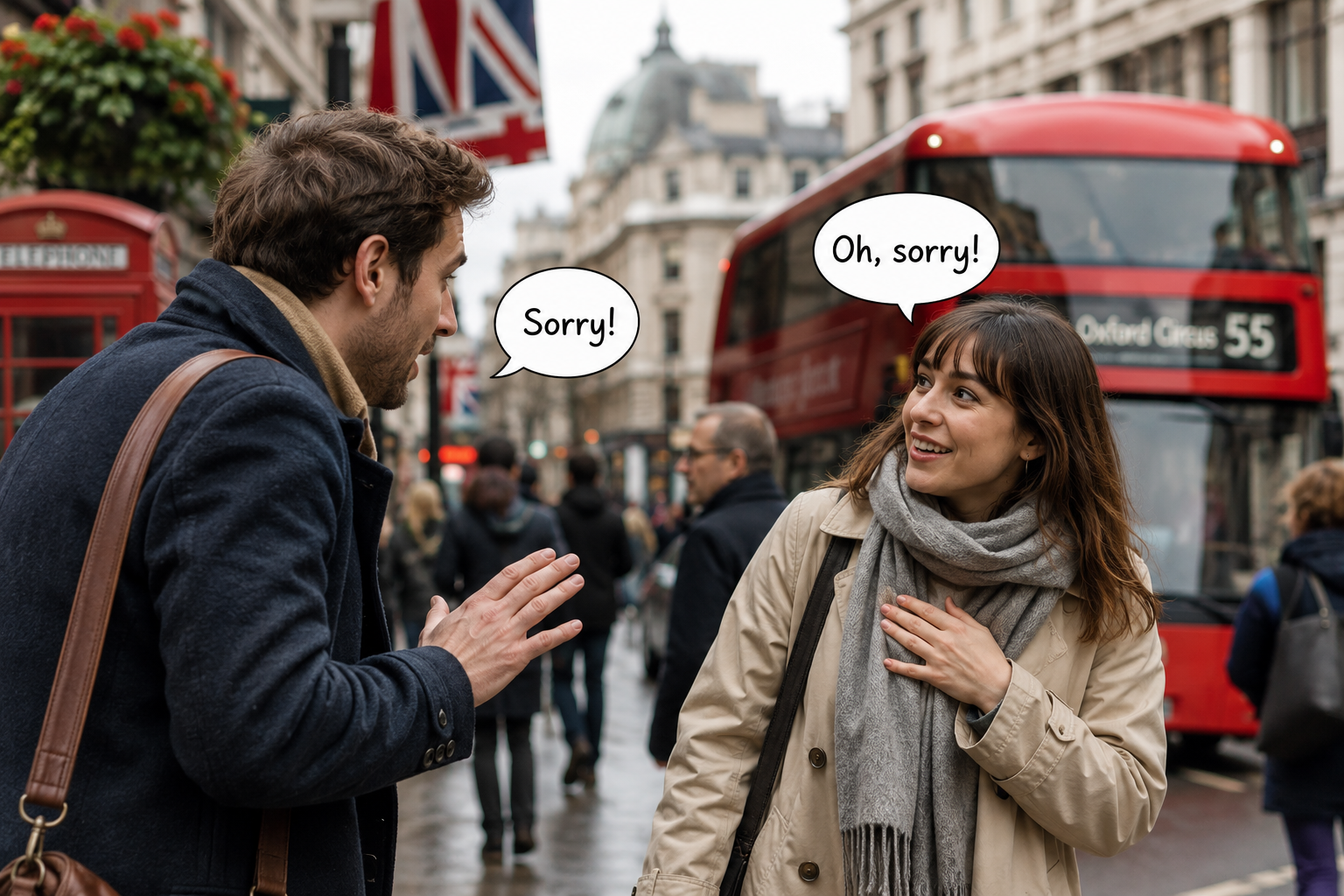
Imagine this: someone bumps into you on a busy London street. You didn’t move an inch. And yet, somehow, you’re the one who says “sorry.” If this sounds familiar, welcome to one of the strangest and most charming quirks of British culture.
Ask anyone who has spent time in the UK, and they’ll tell you the same thing: British people apologise constantly. They say sorry when they haven’t done anything wrong, sorry when someone else bumps into them, and sorry when they’re simply trying to get past you in a supermarket aisle. For English learners, this can be genuinely confusing. Does “sorry” always mean an apology? And if not, what on earth does it actually mean?
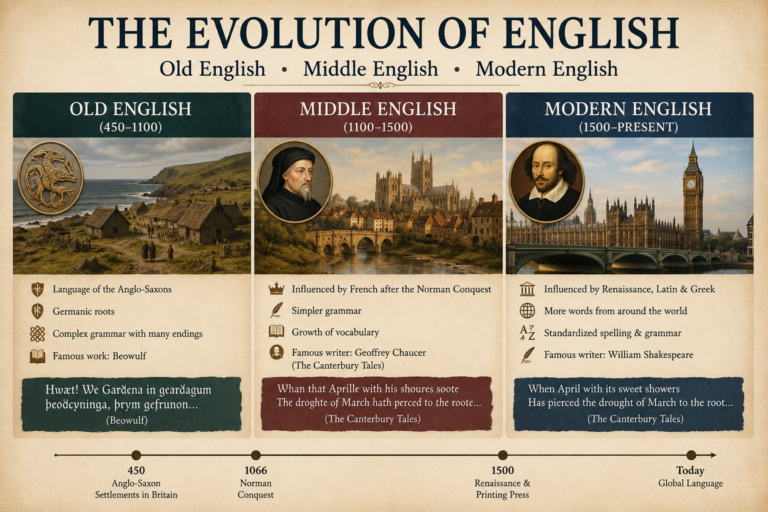
Britain’s polite communication style has developed alongside the evolution of the English language itself. To understand that journey, read Old English, Middle English and Modern English: How the English Language Evolved Through Time.
The truth is that “sorry” is one of the most flexible, most misunderstood, and most quintessentially British words in the entire language. It’s not really about guilt at all — it’s about social smoothing. In this article, we’ll explore the fascinating history behind this habit, unpack the many hidden meanings of “sorry,” and give you the practical tools to start using it just like a native speaker.
Quick Answer
British people say “sorry” so often because it functions less as an apology and more as a social tool — used to soften requests, avoid confrontation, show politeness, and maintain harmony in everyday interactions. It rarely signals genuine guilt; instead, it’s a verbal cushion that keeps British social life running smoothly.
The Cultural Roots of British Apologising


To understand why “sorry” is everywhere in British speech, it helps to look at British culture more broadly. The UK has long placed enormous value on modesty, restraint, and avoiding conflict in public life. Where some cultures value directness, British culture has traditionally prized understatement and indirect communication.
Britain’s polite communication style has developed alongside the evolution of the English language itself. To understand that journey, read Old English, Middle English and Modern English: How the English Language Evolved Through Time.
This isn’t a new phenomenon. Diplomacy, self-deprecation, and a horror of “making a fuss” have shaped British social behaviour for generations. Saying “sorry” fits perfectly into this mindset. It smooths over awkwardness, avoids the risk of seeming rude, and keeps everyday interactions calm and comfortable.
In many ways, British apologising isn’t about admitting fault. It’s about protecting the social atmosphere. A quick “sorry” acts like a small peace offering, letting everyone involved know that no one wants any trouble.
Is “Sorry” Really an Apology? The Many Hidden Meanings
Here’s the twist that surprises most learners: in British English, “sorry” very often has nothing to do with wrongdoing at all. Instead, it can mean any of the following, depending on context and tone.
1. “Excuse me”
Used to get past someone or get their attention politely.
2. “Could you repeat that?”
Said with rising intonation when you didn’t hear something clearly.
3. “I disagree, but politely”
A gentle way to soften disagreement before stating your actual opinion.
4. Sympathy, not apology
Used to express empathy for someone else’s bad news, even when you had nothing to do with it.
5. A conversational filler
Simply a way to pause, soften a sentence, or ease into a request.
This flexibility is exactly why “sorry” causes so much confusion for English learners. Its meaning shifts entirely depending on tone, situation, and body language — something textbooks rarely explain properly.
Sorry in Different Situations
Let’s look at how “sorry” changes shape across everyday British life.
- On public transport: “Sorry, is this seat taken?” — a polite way to ask a question, not an apology.
- In a shop: “Sorry, do you have this in a smaller size?” — softening a simple request.
- When someone shares bad news: “Oh no, I’m so sorry to hear that.” — pure sympathy.
- When bumping into someone: “Sorry!” — genuine, but often said by both people, even if only one caused it.
- When disagreeing: “Sorry, but I don’t think that’s quite right.” — a gentle cushion before disagreement.
Notice how in almost none of these examples does “sorry” express real guilt. It’s a linguistic lubricant, keeping conversations polite and low-friction.
Why Politeness Matters So Much in Britain
British communication style leans heavily on indirectness. Rather than stating things bluntly, speakers often “wrap” their meaning in softening language — and “sorry” is one of the most common wrapping tools available.
This reflects a broader cultural value: avoiding direct confrontation. Where a more direct culture might say “Move, please,” a British speaker is far more likely to say “Sorry, could I just squeeze past?” The underlying request is identical, but the delivery feels gentler, less demanding, and more considerate of the other person’s feelings.
For learners, understanding this pattern unlocks a huge part of natural British communication. Once you notice how often “sorry” is used to soften rather than apologise, British conversations become much easier to follow — and much easier to join in with confidently.
British English Learner’s Corner ⭐
Vocabulary
- Sorry – used for apology, sympathy, or politeness
- Excuse me – used to get attention or move past someone
- My apologies – a more formal way to say sorry
- No worries – a casual response when someone apologises to you
- Pardon? – a polite way to ask someone to repeat themselves
- Fuss – unnecessary drama or complaint
- Awkward – uncomfortable or embarrassing
Everyday Phrases
1. “Sorry, could I just get past?”
2. “Sorry, what was that again?”
3. “Sorry to bother you, but…”
4. “Oh, I’m sorry to hear that.”
5. “Sorry, but I see it a bit differently.”
Mini Dialogue
Tom: Sorry, is anyone sitting here?
Amy: No, go ahead!
Tom: Sorry, thanks. Oh — sorry, did I just step on your bag?
Amy: Ha, no worries at all!
Pronunciation Tip
In British English, “sorry” is usually pronounced with a short “o” sound, closer to SO-ree, rather than the American SAH-ree. Listen for this subtle vowel difference when watching British TV or films.
British vs American English: Sorry Compared
| Situation | British English | American English |
| Getting past someone | “Sorry, excuse me” | “Excuse me” |
| Didn’t hear something | “Sorry?” | “Sorry?” / “What?” |
| Disagreeing politely | “Sorry, but I don’t think so” | “I don’t think so” |
| Someone else’s mistake | “Sorry, my fault!” (even if not) | Less common to apologise for others’ errors |
While American English also uses “sorry,” British English tends to use it far more frequently, and more often as a softening device rather than a genuine apology.
Did You Know?
A widely cited 2016 survey found that the average British person says “sorry” around eight times a day — and some estimates suggest they may apologise up to 1.9 million times over the course of a lifetime. Many respondents even admitted to saying “sorry” to inanimate objects, like furniture they’d bumped into.
Common Mistakes English Learners Make
- Assuming “sorry” always means guilt. Many learners over-apologise or under-apologise because they take the word too literally.
- Using “sorry” only for big mistakes. In British English, it’s also used for tiny, everyday moments of politeness.
- Missing the tone. The same word can sound like genuine remorse or light politeness — intonation matters enormously.
- Overusing “I apologise” in casual settings. This sounds too formal for everyday situations; “sorry” is far more natural.
- Forgetting the double “sorry” habit. When two people bump into each other, it’s completely normal — and expected — for both to say sorry.
Key Takeaways
- “Sorry” in British English is rarely about real guilt — it’s a social tool.
- It can mean “excuse me,” “pardon,” sympathy, or a softener before disagreement.
- British culture values indirectness, and “sorry” fits naturally into that style.
- Tone and context matter more than the literal word itself.
- Native speakers often say “sorry” many times a day, sometimes without even noticing.
- Understanding this habit helps learners sound far more natural in everyday conversation.
FAQ
Why do British people say sorry when it’s not their fault?
Because “sorry” often functions as a social softener rather than an admission of guilt, helping to keep interactions polite and friction-free.
Is it rude not to say sorry in Britain?
In many everyday situations, skipping “sorry” can come across as blunt or less polite, even if no real apology is needed.
What’s the difference between “sorry” and “excuse me”?
Both can be used to get past someone or gain attention, but “sorry” carries a slightly softer, more apologetic tone.
Do British people mean it every time they say sorry?
Not always. Many uses are automatic, habitual, and more about politeness than genuine remorse.
How can I sound more natural when apologising in British English?
Pay attention to tone and context rather than the literal word — a light “sorry” for small moments and a more sincere tone for genuine mistakes.