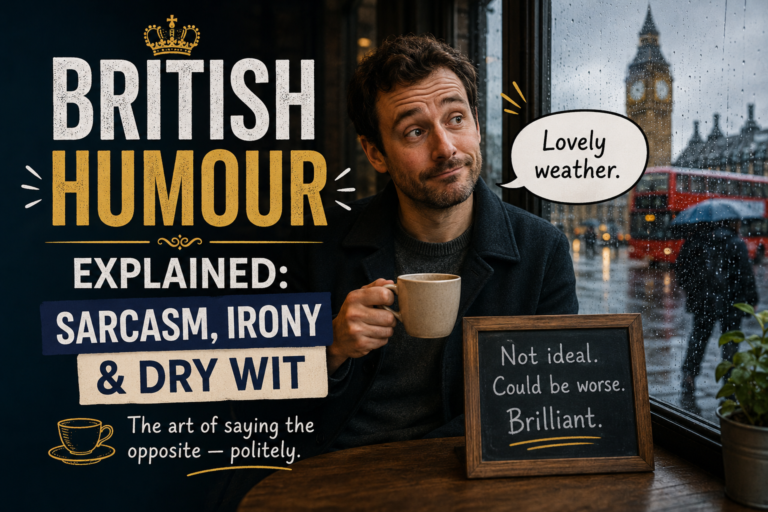
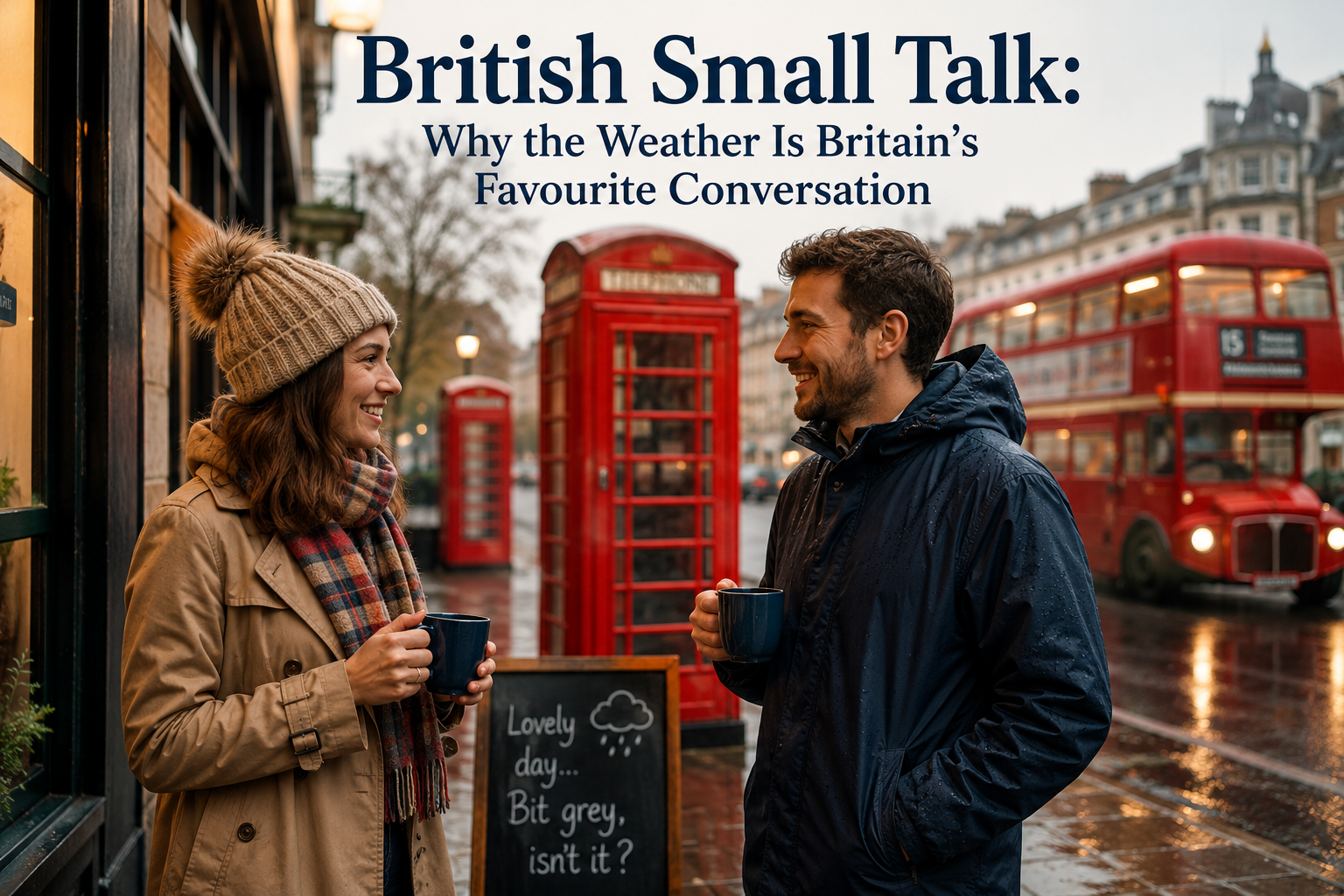
British small talk is a fascinating part of everyday British English, and one of its most recognisable features is the British habit of talking about the weather. You are standing in a lift. The doors close. There is one other person in there with you, and you have, at most, thirty seconds together before the doors open again and you go your separate ways forever.
What happens next depends entirely on where you are in the world. In some places, this is a comfortable silence. In Britain, it is very rarely that. Somebody will look up, glance briefly at the ceiling as though checking for rain that could not possibly reach them indoors, and say something like, “Bit grey out there today, isn’t it?”
You are not being told anything useful. You already know what the sky looks like. And yet, somehow, the moment softens. The silence, which was starting to feel loaded, has been quietly defused.
That is the entire purpose of the sentence, and it has almost nothing to do with meteorology.
It Was Never Really About the Weather
Ask most people why the British talk about the weather so much, and they will laugh and say something about the unpredictable climate — four seasons in one afternoon, and so on. That is part of it, certainly.
But the deeper reason is social, not scientific.
Weather is the one subject that is genuinely safe to raise with a total stranger. It does not touch on money, religion, class, politics, or family — all the things a well-mannered person in Britain has traditionally been trained to avoid in casual conversation.
It asks nothing of the other person and reveals nothing about you.
It simply says:
I see you. I acknowledge that we are sharing this moment. I mean you no harm.
In that sense, weather talk functions less like a topic of conversation and more like a small bow. A verbal nod.
The words matter far less than the gesture behind them.
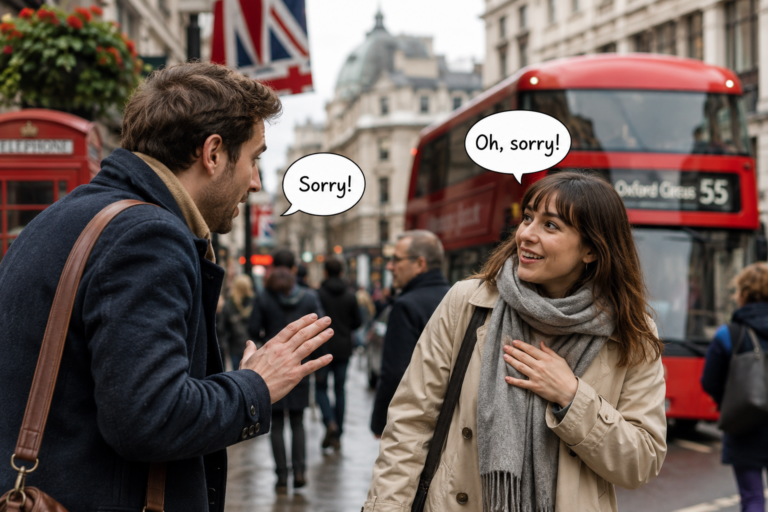
It is, in some ways, a cousin of another very British reflex — the way an entire nation apologises for things that were never its fault in the first place.
If you have ever wondered why someone might say sorry after you step on their foot, it is really the same instinct at work: smoothing a moment over before it can become awkward.
A Habit With Deep Roots
This is not a modern quirk.
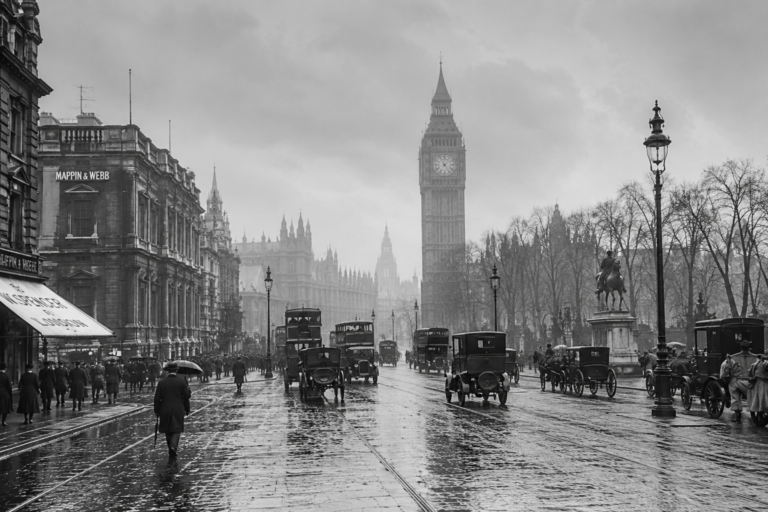
Britain has long been a society shaped, quite literally, by its skies. For centuries, an agricultural economy meant that a sudden downpour or an unexpected frost could make the difference between a good harvest and a ruined one.
Talking about the weather was not small talk at all back then — it was genuinely important information, discussed with real urgency at markets, in fields, and over garden fences.
By the time the Victorians came along, that practical habit had been folded into something more social.
Etiquette manuals of the era placed enormous emphasis on avoiding topics that might embarrass, offend, or expose a difference in rank between speakers.
The weather, wonderfully, offends no one.
A duchess and a delivery boy can agree with equal sincerity that it does seem to be clearing up. Few other subjects in the English language manage that particular trick.
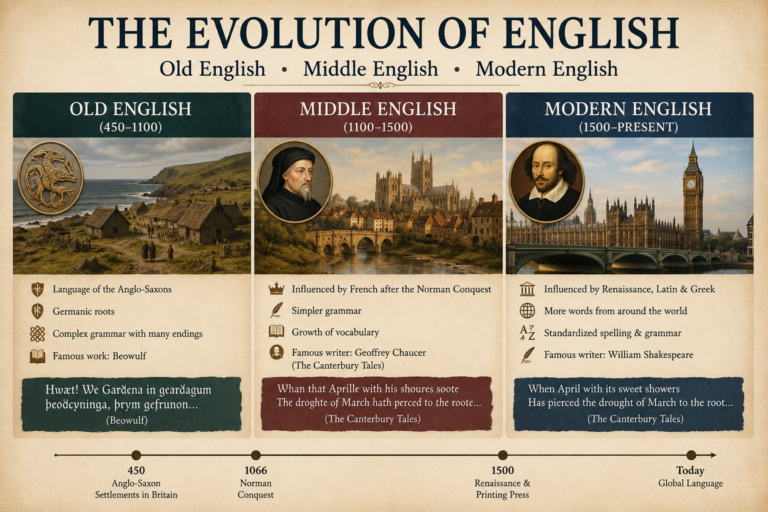
What is especially charming is that the language itself has been shifting and reshaping around this habit for well over a thousand years — the same way English as a whole has quietly evolved from something almost unrecognisable into the version we speak today.
It is a story worth knowing on its own, and one we have traced in more detail elsewhere, from the earliest roots of the language right through to the polished English spoken now.
A Quick Scene to Picture
Two strangers wait at a bus stop in the rain.
One glances at the sky and murmurs:
“Typical, isn’t it — the one day I left my umbrella at home.”
The other gives a small, knowing smile.
Nothing more is said.
And yet an entire unspoken agreement has passed between them:
we are both stuck here, we are both slightly irritated, and we are, for these few minutes, quietly on the same side.
That is a great deal of communication for six words about rain.
The Unwritten Rules
Like most British customs, weather small talk comes with rules that are never taught directly and yet somehow everybody seems to know.
Get them right, and you blend in effortlessly.
Get them wrong, and — however good your grammar — you mark yourself out as someone still learning the culture rather than living inside it.
A few of those unwritten rules:
- Mild complaint is welcome; genuine complaint is not. “Ugh, this rain again” said with a small smile is charming. Said with real frustration, it becomes oddly uncomfortable for everyone involved.
- Agreement is expected, not information. If someone says the weather is turning colder, the correct response is rarely a competing weather fact. It is simply a warm, agreeing sound — “Mm, it really has, hasn’t it” — that keeps the moment gentle rather than turning it into a debate.
- Understatement is everything. A heatwave becomes “a bit warm today.” A storm becomes “not the nicest weather we’ve had.” Overreacting, even to something dramatic, can feel faintly un-British.
- It is often an apology in disguise. Running two minutes late, cancelling on short notice, or interrupting someone at their desk — a well-placed comment about the weather (“sorry, awful traffic in this rain”) can soften the moment almost as effectively as an outright apology. It is worth noticing how often these small verbal cushions show up together in everyday British conversation once you start listening for them.
Another Small Scene
Two colleagues step into the office lift on a scorching July afternoon.
One fans herself lightly with a folder and says:
“Warm one, isn’t it.”
The other nods, entirely unbothered, and replies:
“Mm, a little close today, yes.”
Neither of them has said the word hot.
Somehow, that restraint is the whole charm of it.
Why the Weather Survives Every Generation
It would be easy to assume that in the age of smartphones and instant messaging, this old habit might be fading.
It is not.
If anything, it has adapted.
Weather comments now open text messages, precede video calls, and fill the first line of emails between colleagues who have never met in person:
“Hope you’re staying dry over there”
before getting to the actual point.
Part of the reason it endures is that it works at every social distance.
It suits close friends catching up after months apart just as easily as it suits two people who will exchange perhaps four sentences in their entire lives.
Few conversational tools are quite so flexible.
From Small Talk to Real Elegance
Here is where it gets genuinely interesting for anyone learning English rather than simply observing it from the outside:
How something is said in these small exchanges carries far more weight than what is said.
“It’s raining” and “It does seem to be coming down rather heavily” are, technically, the same piece of information.
But one sits flat on the page, and the other has a certain lift to it — a warmth, a lightness, almost a wink built into the phrasing.
This is really the heart of refined English.
It is not about longer words or stiffer grammar.
It is about choosing the phrase that carries a little more grace without ever sounding forced — the difference between saying something and saying it well.
It is a skill, and like any skill, it can be learned, practised, and eventually made to feel completely natural.
If you enjoy noticing that kind of detail — the small, elegant choices that turn an ordinary sentence into something with a bit of polish — it is exactly the sort of thing we spend a good deal of time unpacking in our video lessons, working through real situations line by line until the more graceful phrasing starts to feel like second nature rather than a performance.
For plenty more everyday scenarios exactly like the ones above — the lift, the bus stop, the office small talk — worked through phrase by phrase, it is well worth spending some time browsing through similar real-world conversations broken down in detail, the kind that show you not just what to say, but how to say it with a little more polish.
One Last Scene
At a garden party, a guest arriving late glances up at the darkening sky and says to her host:
“I do hope this holds off until after the cake — it would be a terrible shame to lose the garden to a downpour just as things were getting lovely.”
It is, in the end, still a comment about rain.
But it has been dressed rather beautifully for the occasion.
A Few Fascinating Facts
- The phrase “talk of the weather” has been used to describe idle, safe conversation in English since at least the 1700s — long before “small talk” itself became common phrasing.
- Britain has such a rich vocabulary for rain — drizzle, mizzle, spitting, chucking it down, bucketing — that some linguists have counted well over a hundred informal terms for it in regional English.
- Weather small talk is considered so central to British identity that visiting dignitaries have long been coached to expect it as an opening pleasantry at almost every formal occasion — a tiny, universal icebreaker that works at every level of society.
- Surveys on British conversation habits have repeatedly found that the weather remains the most commonly used opening line between strangers, ahead of any other topic by a wide margin.
- Even the British monarchy’s own garden parties are said to run partly on weather-related contingency planning — a very English example of how deeply the national obsession runs, right down to royal event planning.
The Quiet Warmth Behind It All
Perhaps that is the loveliest thing about British small talk — how much warmth it manages to carry while appearing to say almost nothing at all.
A comment about clouds becomes a small act of kindness.
A shared complaint about rain becomes, briefly, a shared moment between strangers who will likely never speak again.
It is not really about the weather.
It never was.
It is about two people, however briefly, choosing not to be strangers for thirty seconds in a lift.
And once you start noticing it, you notice it everywhere — in the sorry murmured after someone else’s mistake, in the way the language itself has quietly reshaped its own manners across a thousand years, and in the dozens of small, real conversations happening around Britain every single day, each one a little more graceful than it needed to be.