Introduction: Why Did He Just Say “Lovely Weather”?
Imagine this.
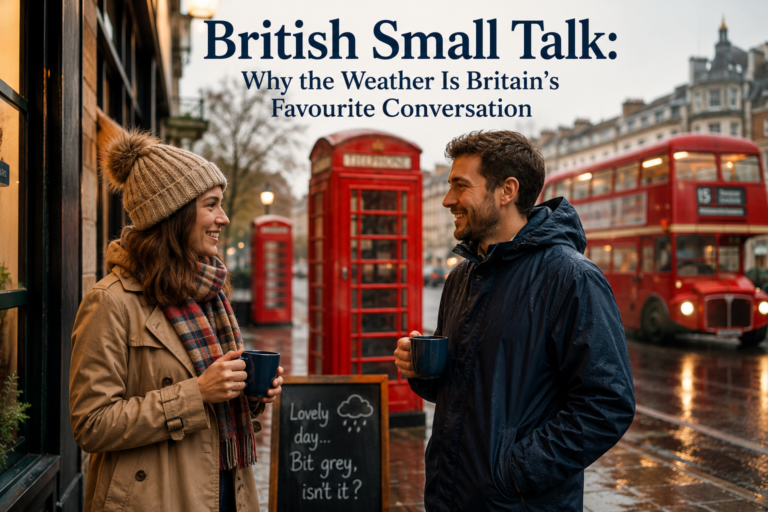
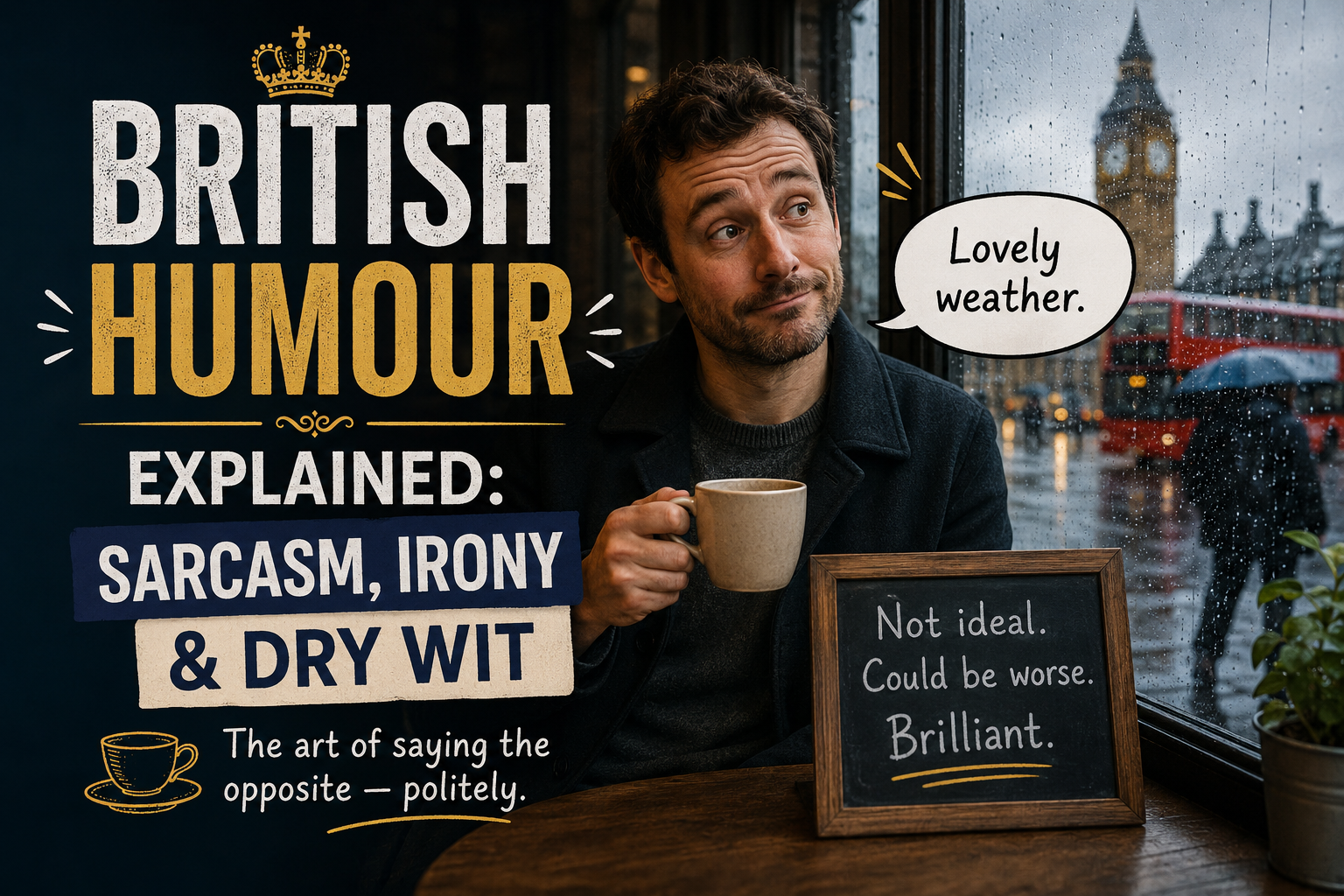
You are in Britain. It is raining so heavily that the pavement looks like a small river. The sky is grey, your shoes are wet and everyone around you is carrying an umbrella.
A British colleague looks out of the window and says:
“Lovely weather.”
You look outside.
Lovely?
You may think they have lost the plot.
But they probably have not. They may be joking.
This tiny sentence reveals something fascinating about British humour: sometimes the most important part of a sentence is not what the words literally say.
It is what the speaker expects you to understand.
British humour often plays with the gap between words and reality, using sarcasm, irony, understatement and dry wit. A person may describe a disaster as “a bit unfortunate”, call terrible weather “lovely”, or look at a completely broken computer and say, “Brilliant.”
For an English learner, this can be genuinely confusing.
You may know every word in the sentence and still miss the joke.
And there is a reason for that.
Understanding British humour is not simply a matter of learning more vocabulary. It involves learning how context, tone, timing and shared knowledge change meaning.
In fact, researchers studying irony and sarcasm have found that understanding non-literal language involves working out what the speaker actually intends, rather than simply processing the literal words.
So, let’s look beneath the surface.
Quick Answer: What Is British Humour?
British humour often uses irony, sarcasm, understatement and dry wit to create humour through contrast. Someone may calmly describe a terrible situation as “not ideal” or say “brilliant” after something goes wrong. The meaning depends heavily on context, tone and the relationship between the speakers — not just the words themselves.
Table of Contents
Why Is British Humour Difficult to Understand?
Here is the strange thing about humour: the sentence itself may not contain the joke.
The joke may exist in the relationship between the sentence and the situation.
Imagine someone drops an entire tray of food in a restaurant.
Their friend says:
“Smooth.”
The word smooth normally describes something that is graceful or well done.
But the person has just done the opposite.
The humour comes from the contrast.
This is why learners sometimes struggle with British humour. They are listening for a conventional joke, but the speaker may be doing something much subtler.
A useful question is not simply:
“What does this sentence mean?”
Instead, ask:
“Why did they choose to say it like that, in this situation?”
That question will take you much further.
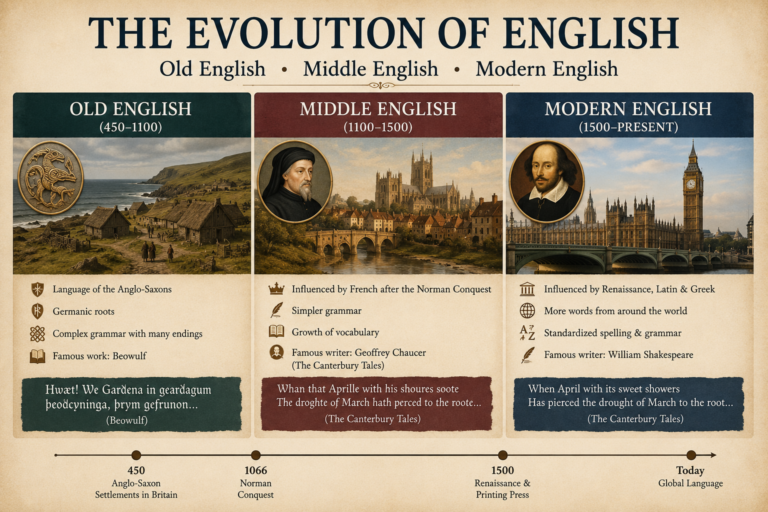
If you’re curious about how the English language itself evolved from Old English through Middle English into the language we use today, explore our guide to [the evolution of English].
What Is British Sarcasm?
Sarcasm is a form of non-literal language in which a speaker says something that can contrast sharply with what they actually intend, often to mock, criticise or tease.
For example, imagine your friend arrives forty minutes late.
You say:
“Nice of you to join us.”
You are probably not genuinely praising their punctuality.
You are pointing out that they are late.
Another example:
Someone accidentally deletes an important document.
Their colleague says:
“Excellent work.”
The literal words sound positive.
The actual meaning is very different.
Academic research often describes sarcasm as a form of irony directed towards a person, frequently with a critical intention.
But there is an important warning here.
Not every sentence that means the opposite is sarcasm.
And not every sarcastic comment is necessarily British.
Sarcasm is used in many varieties of English.
What can feel particularly British is the way sarcasm may be combined with understatement, politeness and an extremely calm delivery.
That combination can make it wonderfully difficult for learners to detect.
What Is Irony?
Irony is related to sarcasm, but the two words should not simply be treated as synonyms.
A useful starting point is:
Irony creates a contrast between what appears to be true or expected and what is actually happening.
Imagine a fire station catches fire.
The situation itself is ironic because the place associated with dealing with fires has experienced one.
Conversational irony can work differently.
Imagine someone arrives five minutes after the train has left.
You say:
“Perfect timing.”
The words suggest excellent timing.
The reality suggests the exact opposite.
That contrast creates the humour.
Interestingly, linguists continue to debate the precise boundaries between irony and sarcasm. They are related concepts, but researchers do not always use the terms in exactly the same way.
So don’t worry about memorising one rigid definition.
For everyday English, remember this:
Irony is about contrast.
Sarcasm often uses that contrast to tease, mock or criticise someone.
Sometimes they overlap.
What Is Dry Wit?
Now we come to one of the most recognisable styles associated with British humour:
dry wit.
Dry humour is funny partly because the speaker does not appear to be trying very hard to be funny.
The delivery may be calm, serious or almost emotionless.
Imagine someone has just spent three hours trying to fix a computer.
Eventually, the computer stops working completely.
They stare at the screen and say:
“That’s mildly inconvenient.”
Mildly?
It is probably a disaster.
And that is the joke.
British humour is often associated with this kind of restrained or deadpan delivery. The British Council’s guide to British humour also highlights dry, straight-faced delivery as a characteristic comedic technique.
The speaker does not need to shout.
They do not need to tell you that they are joking.
They simply say something understated and allow you to discover the humour yourself.
Why British Humour Loves Understatement
This may be one of the most useful ideas for English learners to understand.
Understatement means presenting something as less important, serious or impressive than it really is.
Consider these examples.
Your flight has been cancelled.
“That’s a bit inconvenient.”
Your computer has completely crashed before an important presentation.
“That’s not ideal.”
You have just experienced an enormous disaster.
“Well, that’s unfortunate.”
The words sound surprisingly calm.
The situation is anything but calm.
That difference creates humour.
British humour frequently plays with this gap between the scale of the event and the scale of the language used to describe it.
Oxford Academic notes the longstanding reputation of British comedy for dry and reserved forms of expression, while also showing that British comedy has always been much broader than one single style.
So it would be wrong to say that every British person communicates through understatement.
But understatement is certainly an important tool in the British comic tradition.
The Hidden Importance of Context
Here is where British humour becomes genuinely fascinating.
Take one word:
“Brilliant.”
It can mean several different things.
Situation 1: Genuine
Your friend tells you:
“I got the job!”
You reply:
“Brilliant!”
You are genuinely pleased.
Situation 2: Sarcastic
You arrive at work and discover that the computer system has crashed.
You look at the screen:
“Brilliant.”
Now the meaning may be:
“This is exactly what I didn’t need.”
The vocabulary has not changed.
The grammar has not changed.
The spelling has not changed.
The situation has changed.
This is one reason humour can be difficult for language learners. Research into sarcasm has shown that even humans can struggle to recognise sarcastic intent when an utterance is considered without the surrounding conversational context.
So when watching British television, don’t listen only to the sentence.
Watch what happened immediately before it.
Listen to the speaker’s tone.
Notice their facial expression.
And ask yourself:
“Does the literal meaning fit the situation?”
If it clearly does not, you may be looking at irony or sarcasm.
And if you want to understand the historical background behind many of Britain’s cultural habits, our guide to [the fascinating history of Britain] is a good place to explore next.
British Humour in Everyday Conversation
Let’s see how this works in ordinary situations.
When it is raining
“Lovely day.”
The weather is dreadful.
The humour comes from the contrast.
When someone is late
“Nice of you to turn up.”
The speaker is probably pointing out the lateness.
When something goes wrong
“Well, that’s gone well.”
It probably has not gone well at all.
When someone makes an obvious mistake
“Very clever.”
Depending on the tone and relationship, this might be playful sarcasm.
When someone drops everything they are carrying
“Smooth.”
Again, the word describes the opposite of what has happened.
Notice something important.
None of these sentences is especially complicated.
A learner could understand every individual word.
Yet the real meaning exists between the words and the situation.
That is the hidden skill you are learning.
British Humour at Work
British humour does not disappear when people enter an office.
In fact, workplace conversations can contain plenty of understated humour.
Imagine a team has spent two hours in a meeting trying to solve a problem.
Someone finally says:
“Well, that was productive.”
Depending on the situation, everyone may understand that very little was achieved.
Or the printer stops working five minutes before an important presentation.
Someone says:
“Excellent timing.”
Again, the humour comes from the mismatch.
But there is an important rule for English learners:
Understanding sarcasm is easier than using sarcasm safely.
With close friends, a sarcastic comment can create warmth and shared amusement.
With a manager, client or stranger, the same sentence can sound rude.
For example:
“Brilliant work.”
between close friends after a silly mistake may be affectionate teasing.
The same sentence from a manager after a serious error could sound genuinely critical.
The words are identical.
The relationship changes the meaning.
When Sarcasm Stops Being Funny
Sarcasm is not automatically humorous.
It can be playful.
It can be affectionate.
It can be critical.
And sometimes, it can simply be unpleasant.
That is why learners should not assume:
“If British people say the opposite of what they mean, I should do the same.”
Not necessarily.
Before using sarcasm, consider:
- Do I know this person well?
- Is the situation relaxed?
- Could they misunderstand me?
- Is the subject sensitive?
- Am I speaking to someone senior to me?
- Could my comment sound insulting?
If you are uncertain, choose straightforward language.
You can become excellent at recognising British humour before you become confident at producing it.
That is actually a much better learning strategy.
British vs American Humour
It is tempting to say:
“British humour is dry and American humour is not.”
That is far too simple.
American English has plenty of sarcasm, irony, deadpan comedy and understatement.
British humour also includes loud, absurd, physical, surreal and highly expressive comedy.
British comedy has a long and varied history, stretching from theatrical traditions to music hall, television, satire and modern sitcoms.
What can sometimes feel distinctive is the combination of dry delivery, understatement, irony and social observation.
Think of programmes such as Monty Python or The Office.
Monty Python’s Flying Circus, first broadcast in 1969, became famous for combining parody, absurdity and satire.
Decades later, The Office helped popularise a very different kind of British comic style: awkwardness, realism, embarrassment and uncomfortable everyday situations.
So British humour is not one thing.
It is better understood as a large family of comic styles.
British vs American English
| Feature | British English | American English |
|---|---|---|
| Sarcasm | Very common | Very common |
| Irony | Common | Common |
| Dry humour | Strong cultural association | Also widely used |
| Understatement | Frequently used | Also used |
| Self-deprecating humour | Common | Common |
| Deadpan delivery | Common | Common |
| Humour in everyday conversation | Often understated in some contexts | Can be more openly expressive in some contexts |
The safest conclusion is not that one culture is “funnier”.
It is that humour has different conversational traditions and expectations, and individuals vary enormously.
British English Learner’s Corner ⭐
7 Useful Words and Expressions
1. Dry humour
Humour delivered in an understated or serious way.
“She has a very dry sense of humour.”
2. Deadpan
A deliberately expressionless or serious way of delivering something funny.
“He delivered the joke completely deadpan.”
3. Sarcastic
Using words that often mean something different from their literal meaning, especially to tease or criticise.
“Was that a sarcastic comment?”
4. Understatement
Making something sound less important or serious than it really is.
“Calling the disaster ‘a bit inconvenient’ was an understatement.”
5. Witty
Clever and amusing in the way something is expressed.
“She’s incredibly witty.”
6. Tongue-in-cheek
Not intended to be taken completely seriously.
“His comment was clearly tongue-in-cheek.”
7. Take the mickey
A British informal expression meaning to tease or make fun of someone.
“Are you taking the mickey?”
5 Everyday British Expressions You May Hear
“Well, that’s gone well.”
Often humorous after something goes wrong.
“Brilliant.”
Can be genuine or sarcastic.
“Lovely weather.”
Can be genuine — or wonderfully sarcastic during terrible weather.
“That’s not ideal.”
Often an understated way of saying something has gone badly.
“Could be worse.”
A characteristically understated response to a difficult situation.
Mini Dialogue
Emma: How’s your morning going?
James: Brilliant.
Emma: That bad?
James: The printer’s broken, I’ve spilled coffee on my shirt and I’ve got a meeting in ten minutes.
Emma: Ah. So, brilliant.
James: Absolutely delightful.
Notice what is happening.
James does not explicitly say:
“My morning has been terrible.”
Instead, he says the opposite.
Emma understands the joke because she knows the context.
That is conversational humour in action.
Pronunciation Tip: Listen to the Delivery
Consider the word:
“Brilliant.”
A genuine version might sound enthusiastic:
“Brilliant!”
A sarcastic version might be flatter:
“…brilliant.”
The difference may come from:
- stress
- pitch
- speed
- pauses
- facial expression
- surrounding context
This is why reading British humour on a page can sometimes be harder than hearing it in a conversation.
Did You Know?
There is a surprisingly deep reason sarcasm can be difficult to understand.
Your brain cannot simply process the words and stop.
You have to work out what the speaker believes, what they know, what has just happened and what they are trying to communicate.
Research from the University of Nottingham used fMRI to investigate how people process ironic and sarcastic comments. The study found differences in the brain networks involved in processing sarcastic and non-sarcastic irony, supporting the idea that non-literal language requires more than straightforward word interpretation.
So when you fail to understand a sarcastic British comment, you are not necessarily missing a vocabulary word.
You may simply be missing the hidden layer of meaning.
Common Mistakes English Learners Make
Mistake 1: Thinking every British joke is sarcasm
British humour is much broader than sarcasm.
It includes wordplay, absurdity, satire, observational humour, physical comedy and many other forms.
Mistake 2: Thinking irony always means “the opposite”
That is a useful starting point for conversational irony, but irony is a broader and more complicated concept.
Mistake 3: Ignoring tone
The same sentence can be sincere or sarcastic.
Mistake 4: Trying to be sarcastic too quickly
Recognition should come before imitation.
Mistake 5: Assuming sarcasm equals rudeness
Sarcasm can be affectionate teasing between friends.
Mistake 6: Taking everything literally
Sometimes the literal sentence is only half of the message.
Key Takeaways
- British humour often depends on context rather than vocabulary alone.
- Sarcasm can use apparently positive words to tease, mock or criticise.
- Irony involves an important contrast between expectation and reality.
- Dry wit often uses calm, understated delivery.
- Understatement can make a serious situation sound amusingly small.
- The same word, such as “brilliant”, can be sincere or sarcastic depending on context.
- British humour is not one single style; British comedy has a long and diverse tradition.
- For English learners, understanding humour is more important than immediately trying to produce it.
Frequently Asked Questions
What is British humour?
British humour is a broad collection of comic styles found in British culture. It can include sarcasm, irony, dry wit, understatement, satire, wordplay, absurdity and self-deprecating humour. In everyday conversation, context and tone can be particularly important for understanding whether a comment is serious or humorous.
Why is British sarcasm difficult to understand?
British sarcasm can be difficult because the literal words may not match the speaker’s intended meaning. A person might say “Brilliant” when something has gone wrong. Understanding the situation, tone and relationship between the speakers helps reveal whether the comment is sincere or sarcastic.
What is the difference between sarcasm and irony?
Irony generally involves a contrast between what is said, expected or apparent and what is actually meant or happening. Sarcasm is often a more pointed form of verbal irony, frequently directed at a person to tease, mock or criticise them.
What does dry humour mean?
Dry humour is humour delivered in an understated, calm or serious manner. The speaker may describe an obviously disastrous situation as “slightly inconvenient”. The humour comes partly from the contrast between the seriousness of the situation and the restrained way it is described.
Why do British people use understatement?
Understatement is one of several techniques found in British conversational and comedic traditions. By deliberately making something sound smaller or less dramatic than it really is, speakers can create humour, avoid sounding boastful or dramatic, and sometimes soften what they are saying.
How can I understand British humour better?
Pay attention to context, tone, timing and what happened immediately before a comment. When the literal meaning does not seem to fit the situation, consider whether the speaker may be using irony, sarcasm or understatement. Watching British programmes and listening to natural conversations can also help you recognise these patterns.
Final Thought: The Joke May Not Be in the Words
Perhaps the most useful thing you can learn about British humour is this:
Do not always listen only to what someone says. Listen to the relationship between what they say and what is happening.
Someone says:
“Lovely weather.”
You look outside.
Rain.
Wind.
Grey skies.
Now you have two messages.
The first is the literal one:
“The weather is lovely.”
The second is the one the situation gives you:
“The weather is absolutely dreadful.”
That little gap between the two is where the humour lives.
And once you start noticing that gap, British conversations become much easier to understand.
You begin to hear the joke hiding underneath an ordinary sentence.
You notice when “Brilliant” does not mean brilliant.
You recognise when “That’s not ideal” means something has gone spectacularly wrong.
And you realise that British humour is often not about saying something obviously funny.
Sometimes, it is about saying something completely ordinary —
and trusting the other person to notice what you really mean.